Prepared by Glemar “Glem” Barbado Melo
In collaboration with multiple AI research assistants, including ChatGPT, Claude, DeepSeek, Gemini, and Perplexity.
Note: This essay presents an interpretive political analysis informed by scholarly frameworks concerning authoritarian populism, fascistic tendencies, cult-of-personality politics, and sacralized leadership. Reasonable readers may disagree about how those frameworks apply to contemporary political developments.
⸻
The Political Meaning of Trump-as-Jesus Imagery
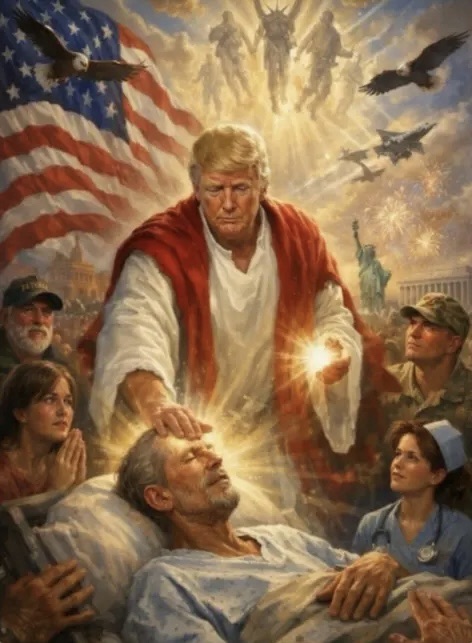
Recent depictions of Donald Trump in overtly Christ-like or messianic visual form should not be dismissed as mere internet absurdity, harmless fandom, or isolated religious excess. They may plausibly be understood as part of a larger symbolic phenomenon: the sacralization of leadership through propagandistic iconography.^1
Trump and the MAGA movement appear to be advancing a political project that critics characterize as increasingly authoritarian, ultra-nationalist, racialized, oligarchic, and patriarchal within the United States.^2
Importantly, this project does not operate in spite of democratic support, but partly through it. Although it draws substantial support from popular majoritarian sentiment, critics argue that its political logic reflects an increasingly illiberal form of populism in which claims of majority mandate are invoked to justify the erosion of liberal-democratic norms and protections.^3 In such frameworks, electoral legitimacy is treated not as one component of constitutional government, but as a license to subordinate institutional constraints, minority protections, and procedural limits to the will of the perceived majority.
This dynamic helps explain why many observers caution against simplistic assumptions that authoritarianism always arises in opposition to popular politics. Modern authoritarian and quasi-authoritarian movements often emerge through democratic mechanisms while simultaneously weakening the liberal constitutional structures that constrain power.^4
Against this backdrop, some scholars interpret aspects of Trumpism as historically resembling those associated with interwar fascist movements, while others argue it is better understood as a distinct form of authoritarian populism exhibiting fascistic tendencies rather than fascism proper.^5 Although important differences in historical context, institutional arrangements, and media environment distinguish contemporary America from interwar Europe, such comparisons persist because analysts repeatedly identify overlapping traits: leader-centric politics, nationalist mythmaking, racialized and gendered identity hierarchies, concentration of elite economic and political influence, hostility toward pluralist constraints, delegitimization of opposition, and the use of emotionally charged propaganda to fuse political loyalty with collective identity.^6
Within that broader context, Trump-as-Jesus imagery takes on significance beyond mere provocation.
Sacralized political imagery fits this pattern precisely because it can convert political loyalty into moral or quasi-spiritual allegiance, placing the leader beyond ordinary accountability.^7
When political imagery symbolically merges a leader with sacred or quasi-sacred status, it can function to elevate that leader above ordinary political contestation. The leader is no longer presented merely as a politician to be evaluated, criticized, or opposed, but as a providential figure whose authority carries moral, historical, or even spiritual significance. Political disagreement then becomes easier to frame not as legitimate dissent, but as disloyalty, sacrilege, or rebellion against a higher cause.
This is a classic feature of cult-of-personality politics.^8
Thus, the Trump-as-Jesus imagery may plausibly be interpreted as propagandistic iconography intended to foster a cult of personality and reinforce support for that broader authoritarian-populist project. Whether every creator of such imagery consciously intends this effect is ultimately secondary; political symbols often function powerfully regardless of the subjective intentions behind them.^9
The issue, then, is not whether every Trump supporter consciously embraces authoritarianism, nor whether every use of religious language in politics is inherently improper. The issue is whether the symbolic and institutional patterns now visible increasingly reflect a movement in which personal loyalty to the leader, rather than principled commitment to liberal-democratic constitutional norms, becomes the organizing center of public allegiance.
That is a question citizens must confront with utmost seriousness.
⸻
Footnotes / Endnotes
1. Emilio Gentile, Politics as Religion (Princeton University Press, 2006); Jan Plamper, The Stalin Cult (Yale University Press, 2012).
2. For critical analyses of Trumpism emphasizing authoritarian, nationalist, racialized, oligarchic, and patriarchal dimensions, see Ruth Ben-Ghiat, Strongmen (W.W. Norton, 2020); Jason Stanley, How Fascism Works (Random House, 2018); Sarah Churchwell, Behold, America (Basic Books, 2018).
3. Cas Mudde and Cristóbal Rovira Kaltwasser, Populism: A Very Short Introduction (Oxford University Press, 2017); Jan-Werner Müller, What Is Populism? (University of Pennsylvania Press, 2016).
4. Steven Levitsky and Daniel Ziblatt, How Democracies Die (Crown, 2018); Nancy Bermeo, “On Democratic Backsliding,” Journal of Democracy 27, no. 1 (2016): 5–19.
5. Robert O. Paxton, “The Five Stages of Fascism,” The Journal of Modern History 70, no. 1 (1998): 1–23; Federico Finchelstein, From Fascism to Populism in History (University of California Press, 2017); Daniel Steinmetz-Jenkins, ed., Did It Happen Here? (W.W. Norton, 2024).
6. Jason Stanley, How Fascism Works; Ruth Ben-Ghiat, Strongmen; Federico Finchelstein, From Fascism to Populism in History.
7. Emilio Gentile, Politics as Religion; Roger Griffin, The Nature of Fascism (Routledge, 1993).
8. Harold Lasswell, “The Psychology of Hitlerism,” Political Quarterly 4, no. 3 (1933): 373–384; Jan Plamper, The Stalin Cult (Yale University Press, 2012); Bob Altemeyer, The Authoritarians (self-published, 2006), available at theauthoritarians.org.
9. Murray Edelman, Constructing the Political Spectacle (University of Chicago Press, 1988).

