The Spiritual Cost of Political Compromise
Prepared by Glemar “Glem” Barbado Melo
With research and composition assistance from multiple AI tools.
All Scripture translations are my own unless otherwise noted.
⸻
While this analysis begins with a specific demographic reality, the theological warning applies to all who would place their trust in worldly power rather than in God.
The reference to white evangelicals is not a theological category but a sociological one—used here to identify a historically documented and statistically measurable pattern of political alignment. The theological argument that follows does not depend on race, but on the moral and spiritual implications of that alignment.
By “worldly power,” I mean the use or defense of political authority in ways that are unjust and oppressive, typically characterized by the absence or disregard of legal restraints and by violations of the rights or will of the governed. This includes actions such as attempts to overturn lawful electoral outcomes or the refusal to accept legal constraints on political authority—patterns widely documented in recent American political life and reporting.
⸻
Power does not make you right. It makes you accountable.
⸻
Introduction
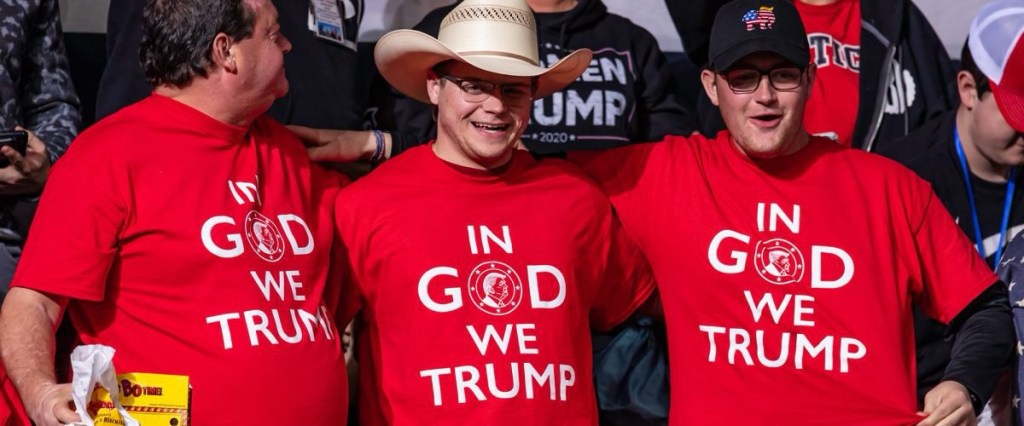
A persistent and overwhelming majority of white evangelicals—roughly 81% in the 2024 election alone, per AP VoteCast—continue to support Donald Trump, as recent polling and post-election analyses confirm.¹–⁷
They call him the lesser evil.
They say it is necessary.
Necessary to stop liberalism,
progressivism,
socialism,
and communism.
That is the justification.
But beneath the language of strategy and necessity lies a deeper, more troubling reality:
a crisis of trust.
⸻
A Question of Trust
“Some trust in chariots and some in horses, but we trust in the name of YHWH our God.”
— Psalm 20:7
The issue is not merely political preference.
It is not about one election cycle or one administration.
It is about whether the people of God trust Him—Father, Son, and Holy Spirit—
or whether they ultimately place their trust worldly power.
By continuing to support Trump as a necessary instrument, the overwhelming majority of white evangelicals are not simply making a political calculation.
They are placing their confidence in a figure of worldly power to accomplish what they believe righteousness requires.
They trust princes.
They trust horses and chariots.
And in doing so, they reveal where their hope truly rests.
⸻
The Calling That Was Set Aside
Christians are not called to participate in injustice
or to manipulate the world.
We are called to bear faithful witness to Christ.
Jesus does not commission His followers to secure outcomes through coercive power, but to faithfully proclaim the truth of the gospel in word and deed—even when that witness is costly.
That calling includes bearing witness:
• to the disadvantaged
• to the outsider
• to the enemy
• and yes, to rulers and authorities
Even to Donald Trump.
Even to the powerful.
Even to the dangerous.
The Church’s role is never to excuse or enable injustice, but to confront it with gospel truth.
To call it to repentance.
To refuse to baptize what God condemns.
To speak clearly, even when influence is at stake.
As Augustine of Hippo famously argued, political structures lacking justice are best understood as forms of organized injustice.⁸
This exposes the moral contradiction at the heart of any political order that claims legitimacy while tolerating or defending injustice.
⸻
What Is Actually Happening
Instead of bearing faithful witness to Christ, the overwhelming majority of white evangelicals continue to choose another path—one marked by moral and theological compromise.
They excuse.
They enable.
They cover.
They harden.
They give religious sanction to what ought to be rebuked.
Rather than proclaiming the biblical gospel, they proclaim distortions of it.
Rather than calling for repentance, they offer justification apart from repentance.
Rather than confronting injustice, they minimize and excuse it.
Rather than remaining set apart, they align themselves with it.
That is not neutrality.
It is participation.
As Dietrich Bonhoeffer argues in Ethics, guilt is not only incurred by direct wrongdoing but also by responsible participation in unjust structures.⁹
In such cases, moral responsibility is not avoided by distance—it is assumed through participation.
How much worse, then, is the open support and defense of injustice and oppression.
⸻
The Spiritual Consequence
When Christians lend their voice to justify injustice, it does not merely compromise their credibility.
They share in the very injustice they refuse to confront.
That has consequences.
Not only for those in power—but for unfaithful Christians as well.
By refusing to name injustice for what it is, by supporting and enabling it,
so many are thereby helping confirm it.
They are not helping turn it away from judgment.
They are helping drive it deeper into judgment.
And in doing so, they do not remain untouched.
They themselves are being shaped by what they defend—
with hardened hearts, not softened;
aligned with injustice, not set apart.
As Scripture warns, those who approve of wrongdoing share in it (Romans 1:32).
⸻
A Biblical Warning
“Come out of her, My people, so that you will not share in her sins and receive her plagues.”
— Revelation 18:4
The command is not merely physical separation.
It is moral and spiritual distinction.
Do not share in her sins.
Do not participate.
Do not justify.
Do not be complicit.
The danger is not only that Babylon sins.
It is that professing believers and churches share in those sins.
⸻
Not About Partisanship
This is not about Democrats versus Republicans.
It is not about left versus right.
It is about something deeper and more enduring:
whether professing Christians trust God—or worldly power.
This same failure appears wherever Christians justify injustice for the sake of influence—whether on the right or on the left.
The temptation is to win. The call is to witness.
Any political movement—left or right—that demands moral compromise in exchange for influence places Christian individuals and churches in the same position.
And the standard does not change.
God’s people are not permitted to commit or support evil so that good may come.
Scripture consistently teaches that profession without obedience is empty (James 2:17), that the children of God are distinguished by their practice of justice and righteousness (1 John 3:10), and that a tree is known by its fruit (Matthew 7:16–20).
It must be said clearly: Christians can err politically, even seriously.
But when such support becomes persistent, unrepentant, and theologically defended—despite clear injustice—it is no longer mere error.
It reflects a settled moral posture.
It evidences a deeper spiritual disorder.
Therefore, those who unrepentantly persist in supporting or excusing such injustices thereby give evidence that their profession of faith is hollow—unless they repent.
As John Calvin warns, invoking the name of God to justify wrongdoing is not true religion but a corruption of it.¹⁰
⸻
The Way Back
The call of Scripture is not merely to critique—but to repent.
To return.
To realign with the gospel and the mission Christ actually gave.
For those who have supported or excused injustice and oppression, repentance begins with truth:
• to name wrongdoing clearly, without qualification or deflection;
• to refuse to justify it—even when it benefits one’s own side;
• to withdraw moral endorsement from what God condemns;
• and to bear public and private witness to what is right, even at personal cost.
Only then can the Church recover its integrity as a faithful witness.
Indeed, Christians do not need more access to worldly power.
We need genuine purity and covenant loyalty to Christ—that is, the wholehearted allegiance due to Him as Lord.
⸻
Final Word
The question is not whether political engagement is allowed.
It is whether trust has been misplaced.
When professing Christians place their trust in worldly power,
they lose their ability to speak prophetically to it.
But when they return to trusting God—
fully, unapologetically, without compromise—
they become what they are always meant to be:
Spirit-empowered witnesses
to Christ—
to His love,
His truth,
and His justice.
⸻
“Now the ax is already poised at the root of the tree. Every tree therefore that does not produce good fruit is cut down and thrown into the fire.”
— John the Baptist, bearing witness to Christ’s inaugurated judgment (Matthew 3:10)
⸻
Sources
1. Pew Research Center. How the Faithful Voted: A Preliminary 2016 Analysis. November 9, 2016.
2. Pew Research Center. How the Faithful Voted: A Preliminary 2020 Analysis. November 9, 2020.
3. AP VoteCast. Election 2020 Voter Analysis. 2020.
4. National Election Pool Exit Polls. National Exit Polls, 2016–2020. Edison Research.
5. AP VoteCast. Election 2024 Voter Analysis. 2024.
6. Public Religion Research Institute (PRRI). American Values Survey. 2024–2025.
7. Gallup. Party Identification and Presidential Approval Trends. 2024–2026.
8. Augustine of Hippo. The City of God. Trans. Henry Bettenson. London: Penguin, 2003. Book IV, ch. 4.
9. Dietrich Bonhoeffer. Ethics. Trans. Reinhard Krauss et al. Minneapolis: Fortress Press, 2005, 67–68.
10. John Calvin. Institutes of the Christian Religion. Trans. Henry Beveridge. Peabody, MA: Hendrickson, 2008. Book I, ch. 11, sec. 8.

