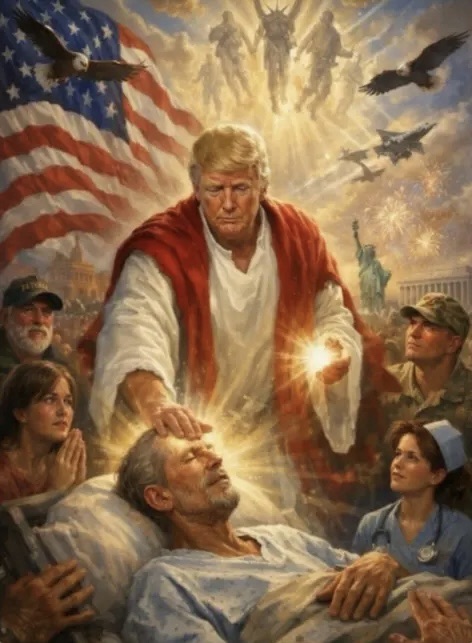
What faithful Christians must do — and refuse — in this moment
by Glem Melo
At a Glance
• Christians must reject both panic (Trump as the final Beast) and idolatry (Trump as God’s anointed) and return to biblical discernment.
• Scripture shows that Christ—not the church—brings history to its consummation, while the task of Christians is faithful, cross-bearing, all-of-life mission across generations.
• The gospel advances not through political domination but through godly witness, patient suffering, and holistic service.
• In this moment, loving our neighbor requires naming injustice and pursuing real reconstruction consistent with Christ’s inaugurated kingdom.
• The call is clear: neither triumphalism nor retreat, but enduring, God-glorifying faithfulness and mission until Christ returns.
What’s God Up To?
There is a question underneath every anxious political conversation happening in churches right now.
It isn’t really about elections. It isn’t really about empires or economies or which leader is ascending or falling.
The question is: What is God doing with history?
And beneath that: What does he require of us while he does it?
Two Temptations to Refuse
There are two ways Christians in the United States are currently misreading this moment — and both of them are wrong.
The first: Trump is the 666. The final Beast. The sign that the end is here. This reading collapses eschatology into current events. It generates panic. It mistakes a wicked and dangerous leader for the culminating figure of Revelation 13 — and in doing so, it distracts Christians from the long, costly, Spirit-empowered work they are actually called to (Matthew 28:19–20).
The second: Trump is God’s servant. Anointed. Raised up for such a time as this. This is the “Christian” nationalist error—and it is not a political mistake. It is a theological one. It sacralizes power (Matthew 4:8–10). It baptizes cruelty (Isaiah 10:1–2). It wraps the gospel in a flag and calls capitulation to empire a form of faithfulness (John 18:36).
This essay refuses both — not as a centrist compromise, but on biblical grounds.
Scripture does not leave the standard abstract. Leaders are judged by justice, truth, and their treatment of the vulnerable (Psalm 72:1–4; Jeremiah 22:3). Where those are persistently violated, accountability is not optional—it is required (Romans 13:3–4). In a constitutional order, that accountability necessarily takes lawful political form.
Trump is a wicked and harmful leader who must be opposed and impeached — concretely, politically, and without apology. But his opposition is not the mission. And his rise is not the end.
The mission is older and longer than this moment. The end is in God’s hands, not ours to calculate (Matthew 24:36). And Christians have work to do that neither panic nor allegiance will accomplish.
What Regenerate Christians Actually Carry
Before anything else, this needs to be said: Christianity is supernatural.
Every regenerate Christian—everyone genuinely born of the Spirit—has been given the Holy Spirit (Romans 8:9), every spiritual blessing in Christ (Ephesians 1:3), and everything they need for life and godliness (2 Peter 1:3). This is not aspiration. It is present reality.
In Christ’s name, the powers of darkness can be driven out (Luke 10:17–19). Strongmen can be bound (Matthew 12:29). Wicked mountains can be moved (Mark 11:23). Evil trees can be uprooted (Luke 17:6). The language is deliberate—rooted in Jesus’ teachings and the principalities-and-powers framework of the Pauline epistles (Ephesians 6:12; Colossians 2:15). Spiritual warfare is not metaphor to be managed. It is the operative framework for engaging both earthly and spiritual evil.
This is not a claim to political domination or coercive control. The authority in view is spiritual—exercised through prayer, proclamation, and obedience to Christ, not the seizure of worldly power (2 Corinthians 10:3–5).
And the Holy Spirit uses the proclamation and ministry of the gospel as his means to convert and save people (Romans 10:14–17). This matters. Social action is not the mission by itself. Prayer without proclamation is not the mission. The Spirit moves through the gospel announced.
Christ’s gospel is the foundation. Everything else stands on it (1 Corinthians 3:11).
What the Text Actually Shows
The Gospel of Matthew records Jesus saying this before his crucifixion: “This gospel of the kingdom will be proclaimed throughout the whole world as a testimony to all nations, and then the end will come.” (Matthew 24:14)
The Book of Revelation — written to persecuted churches under Roman imperial terror — shows us the result of that proclamation: “a great multitude that no one could number, from every nation, from all tribes and peoples and languages, standing before the throne.” (Revelation 7:9)
This is not wishful thinking. This is eschatological promise. A global harvest is coming. The gospel will reach all nations before the end. That is what Jesus said. That is what John saw.
But the same texts are honest about what accompanies that harvest.
Matthew 24 places witness and persecution side by side. The nations will hear — and the messengers will suffer. The great multitude of Revelation 7 is described in verse 14 as those who “have come out of the great tribulation.” Not around it. Through it.
Mission and persecution are like faith and repentance. They accompany each other. The church was never promised a comfortable path to completion. It was promised a completed mission.
The Long Arc
I believe Christ’s coming is imminent. He could return at any moment (Matthew 24:44; 1 Thessalonians 5:2). The church does not get to know the day or the hour—and it should not act as though it does (Matthew 24:36, 42; 25:13).
At the same time, I want to be honest about what I suspect regarding the time between Christ’s first and second coming. This is personal conviction, not dogma. My impression from Scripture is that the interadvental period is long — possibly far longer than most Western evangelical frameworks have imagined. Long enough for the gospel to reach all nations (Matthew 24:14). Long enough for the cycle of discipling, persecution, harvest, and blessing to run across generations (2 Timothy 2:2; Revelation 7:9). Long enough for all nations to be blessed as Abraham was blessed (Genesis 12:3; Galatians 3:8). And consistent with God’s patient purpose that more would come to repentance (2 Peter 3:9).
These two convictions are not in conflict. Christians work as if the mission is long (Matthew 28:19–20; 2 Timothy 2:2; 1 Corinthians 15:58). They watch as if the end is near (Matthew 24:44; Romans 13:12). Both postures are required (Matthew 24:45–46). Neither cancels the other.
The cycle looks like this:
Discipling nations → persecution → harvest → blessing — and blessing is reconstruction. It is what the nations look like when they are actually being discipled. It is the Abrahamic promise being fulfilled — “all nations will be blessed through you” — in real time, in real societies, through real communities of repentant Christians who bear the marks of the crucified.
That cycle, Spirit-empowered (Luke 24:49; Acts 1:8) and gospel-mediated (Romans 1:16), often carried by the persecuted (Acts 8:4), could run across generations—consistent with God’s covenantal faithfulness to “a thousand generations” (Deuteronomy 7:9).
This does not mean the church brings the kingdom to completion within history. Scripture is clear: Christ does that at his return (1 Corinthians 15:23–24; Colossians 3:4). The task of Christians is faithful witness, not final consummation (Acts 1:7–8; Matthew 24:46).
In the United States, persons of color are oppressed. That is not a sociological footnote. It is a prophetic datum. And historically, the persecuted church has always been the advancing church. Those who have not been seduced by imperial Christianity — those who cannot afford to confuse the gospel with the interests of power — are better positioned to carry a gospel that is actually good news to all nations.
Too many U.S. evangelicals are fake Christians — not a polemical charge, but a Matthean one (Matthew 7:21–23). The Christianity that blessed slavery, that sanctified segregation, and that is now adamant in its support of a wicked and dangerous president — that is not the Christianity of the crucified Messiah. It is a different religion — one actively held by those whom Scripture describes as wolves in sheep’s clothing (Matthew 7:15).
Repentant Christians must rise (Ephesians 5:14), especially those of color. Not to win a culture war, but to advance the Great Commission—in word and in action (1 John 3:18; James 2:17). To pray and fast and drive out evil (Mark 9:29; Isaiah 58:6; James 4:7). To love and serve people, especially the oppressed poor (Matthew 25:40; Luke 4:18; Isaiah 1:17). To share Jesus, make disciples, and plant repentant churches (Colossians 1:28; Matthew 28:19; Acts 14:21–23). And to seek the good of the societies they inhabit (Jeremiah 29:7)—because salvation is holistic, and mission is holistic (Luke 4:18–19; Colossians 1:20). The Lausanne Covenant got this right.
A World That Looks Fine
There is another set of texts that deserves honest attention.
Paul writes to the Thessalonians: “While people are saying, ‘There is peace and security,’ then sudden destruction will come upon them.” (1 Thessalonians 5:3)
Jesus, in Matthew 24 and Luke 17, describes the days before judgment with mundane detail: eating and drinking, marrying and giving in marriage, buying and selling, building. A world that appears to be functioning normally — right before everything breaks open.
This is not a picture of a world obviously careening toward collapse. It is a picture of a world that has learned to normalize what should alarm it. It may also be that a time of genuine “peace and security” emerges globally—before Christ’s return and his Millennial kingdom.
I want to be careful and honest here. Scripture does not give us a precise sequence. It does not explicitly connect the “peace and security” moment to the rise of the system Revelation describes as 666 — the mark of the beast, the global economic-political structure that demands allegiance and punishes refusal (Revelation 13). That connection is synthesis, not assertion.
But my considered reading — held as probability, not dogma — is that it is most likely that they belong together. That the era of normalized stability is the soil in which the Beast system rises, or ripens. Either as its cause or its culmination. This is a synthesis drawn from the convergence of these texts, not an explicit claim made by any single passage.
And no political tribe is immune. Left, center, right — all can be drawn into a structure that opposes Christ while using the language of peace and security.
How to Read This Moment
This is where careful exegesis matters.
Trump is not the 666. The Revelation 13 system is global — a seamless structure of economic control demanding universal allegiance, rising in a world where everyone is saying “peace and security.” That is not this moment. The world right now is not at false peace. It is visibly convulsing — wars, instability, fracture, decline, fear. The conditions that Scripture associates with the final Beast are not yet present. Identifying Trump as the 666 is not prophetic discernment. It is exegetical overreach.
But Trump is not God’s servant either. Scripture is not vague about what God’s servants look like. They pursue justice (Micah 6:8). They protect the vulnerable (Psalm 82:3–4; Proverbs 31:8–9). They tell the truth (Ephesians 4:25). They point away from themselves and toward the living God (John 3:30; 2 Corinthians 4:5). By every biblical measure, Trump bears none of these marks.
The argument that God uses imperfect vessels is true — and irrelevant here. Every leader God raises up in Scripture to serve his redemptive purposes does so by advancing justice and mercy, however imperfectly (Isaiah 44:28; 45:1). What is happening now is the opposite: the crushing of the vulnerable, the rewarding of cruelty, the demand for personal loyalty over truth, and the severe, systemic damage done to the nation (Isaiah 10:1–2; 5:20; Romans 1:25).
To call Trump God’s anointed is not a bold prophetic stance. It reflects a lack of Spirit-given biblical discernment (1 John 4:1; 1 Corinthians 2:14; 12:10) — and that should haunt those who make that claim (2 Corinthians 13:5).
He is a wicked and harmful leader in a perilous moment — neither the culmination of history nor its instrument of redemption. He must be opposed. And Christians must be clear about why.
What Is Clear
Here is what is not speculation.
Christ returns. The Beast falls. That is Revelation 19. And only after that — the Millennium, the earthly reign of Christ with his people (Revelation 20).
This is the historic premillennial position, and it matters: Christ returns first (Revelation 19:11–16). The Millennial kingdom follows after (Revelation 20:1–4). The church does not build the kingdom and hand it to Christ. Christ ushers in the kingdom at his return (Acts 1:7–8; Daniel 2:44).
The sequence forecloses a particular temptation — the belief that if we get the right people in power, if we win the right cultural battles, if we build the right institutions, we can usher in the kingdom ourselves. We cannot (Zechariah 4:6; Daniel 2:44). What we can do — what we are called to do — is extend the reach of the inaugurated kingdom through faithful, costly, cross-bearing witness across generations (Luke 9:23; Mark 4:30–32; Revelation 2:10).
We reconstruct toward the image and likeness of Christ’s kingdom (Matthew 6:10). He closes the age (1 Corinthians 15:23–24; Matthew 13:39; Colossians 3:4). We don’t.
What Faithfulness Actually Looks Like
There are two failure modes for Christians right now.
The first is triumphalism — the belief that “Christian” political victory is the mission, that the kingdom advances through the leverage of earthly power. The gospel does not travel on the back of empire (Zechariah 4:6; Matthew 20:25–26). It travels on the backs of the crucified (1 Corinthians 1:23; 2 Corinthians 4:7–10; Acts 14:22; Revelation 12:11).
The second is paralysis — the belief that because systems of evil will rise, faithful people should withdraw and wait. Scripture rejects that posture (Matthew 5:14–16; 1 Corinthians 15:58; Acts 1:11). The multitude no one can number will not come through the great tribulation by staying home; they will come through it by enduring in faith and witness (Revelation 7:14; 14:12; Matthew 24:14).
The call is neither conquest nor retreat.
Fast. Pray. Be filled with the Spirit. Trust and obey the word of God. Love your repentant church family with the kind of love that costs you something. Share Jesus. Make disciples. Help plant repentant churches — in your city, in your country, across the world. Seek justice. Pursue mercy. For everyone. Everywhere.
All corruption must be exposed (Ephesians 5:11; Luke 8:17). All injustice must be judged (Ecclesiastes 12:14; Psalm 9:8). No leader is untouchable — not because of partisan politics, but because the God who governs history shows no partiality and is not impressed by titles (Deuteronomy 10:17; Romans 2:11; 1 Samuel 16:7; Daniel 2:21).
If this theological framework is sound, then its implications are not confined to the church’s interior life. The gospel grounds Christian mission; that mission extends into every domain where human beings are being formed, harmed, or restored (Romans 12:2; Colossians 1:20). This includes the public and social order, where God’s people are called to seek justice, love mercy, and live visibly before others (James 2:17).
In the United States, this is not abstract. Holistic mission — the kind demanded by Scripture and articulated in the Lausanne Covenant — requires naming what is happening and saying what must change. The United States is in grave peril.
That peril has a shape: a government detaining and deporting image-bearers without due process, a president whose policies have inflicted — and continue to inflict — severe, systemic damage to the nation as a whole, and a country that requires not mere reform but real reconstruction — the kind that reflects and magnifies the justice and mercy of Christ’s inaugurated kingdom.
These are not partisan positions. They are the specific socio-political content of loving your neighbor in this country, in this moment (Matthew 22:39; 1 John 3:18; James 2:15–16; Romans 13:9–10). Christians who fast and pray, share Jesus, and plant churches must also say this plainly — because the gospel that does not address what is crushing people where they are is not the whole, biblical gospel.
Cross-bearing, Jesus-sharing, church-planting Christians will not cause the rise of the final 666 (2 Thessalonians 2:9; Revelation 13:7, 10). They will extend the reach of the kingdom that outlasts it (Daniel 2:44; Revelation 11:15; 12:11).
A Word to the Curious Non-Christian Reading This
You may have landed here skeptical. That’s fair.
What I am not asking you to do is accept a political program or a cultural agenda. What I am asking you to consider is that the biblical story, message, and teaching have a coherence to them—a unified witness centered in Christ (Luke 24:27; 2 Corinthians 1:20). They offer a diagnosis of what is wrong with the world (Romans 3:23; 1 John 5:19) and a claim about who is putting it right and how: God reconciling the world to himself in Jesus Christ through the cross (2 Corinthians 5:19; Acts 4:12).
The biblical diagnosis is that human systems, left to themselves, tend toward the consolidation of power, the demand for total allegiance, and the crushing of those who refuse (Revelation 13:7–8; Matthew 20:25–26; Isaiah 10:1–2; 2 Thessalonians 2:4). History keeps confirming this. The claim is that Jesus Christ—crucified, risen, and reigning—is the one authority who does not do this, but instead lays down his life to rescue and restore the powerless (Matthew 20:28; Philippians 2:6–8; 1 Corinthians 1:27; Matthew 12:20; Colossians 1:20).
If that claim is true, it changes everything about how we live now.
To Christians
Hold your convictions. Test everything by Scripture (1 Thessalonians 5:21). Do not let the anxiety of the moment drive you into the arms of a worldly, political savior.
Jesus is reviving Christians worldwide (Habakkuk 3:2; Acts 3:19–20). He is equipping and mobilizing his people for both evangelistic and socio-political action (Ephesians 4:11–12; Matthew 5:13–16; 28:19–20; Micah 6:8). Multitudes will be converted and saved (Revelation 7:9–10; Acts 2:47). Faithful Christians are suffering and will continue to suffer—but the fire of trials will also purify them, conform them more and more to Christ, and lead them into deeper and greater intimacy with God (1 Peter 1:6–7; Romans 8:29; James 1:2–4).
The harvest is coming (Matthew 9:37–38; John 4:35). The nations will be discipled (Matthew 28:19). Humanity will be blessed (Isaiah 49:6; Acts 13:47). God will glorify himself among all peoples (Psalm 86:9; Malachi 1:11).
That is enough to keep moving.
Holy Spirit of Emperor–Healer Jesus Christ, be merciful to us and help us.
#FastPrayDriveOutEvil
#ShareJesus
#MakeDisciples
#PlantRepentantChurches
#GetUSAoutOfPeril
#ImpeachTrump
#ReconstructUSAforReal
#FreeAllHumanity

