Gospel. Armor. Strongholds. Plunder. A gospel-based, biblical, and theological guide to the war you are already in.
“Believe the good announcement.”
— Emperor–Healer Jesus Christ (Mark 1:15, translations mine)
“For as long as Moses held his hands up, Israel was prevailing; but when he let them down, Amalek was prevailing.”
— Exodus 17:11
“The war is not yours but God’s…. You will not need to fight in this battle. Position yourselves, stand, and see the salvation of YHWH who is with you….”
— 2 Chronicles 20:15–17
“Our struggle is not against blood and flesh, but against the rulers, against the authorities, against the cosmic powers of this darkness, against the spiritual forces of evil in the heavenly places.”
— Ephesians 6:12
“The weapons of our warfare are not fleshly but powerful in God for the demolition of strongholds.”
— 2 Corinthians 10:4
—–
I. The Emperor–Healer Has Already Won
Before we speak of demons, we must speak of Christ.
This is not a pious formality. It is the load-bearing theological claim without which everything else collapses. The entire architecture of biblical spiritual warfare — every command to resist, every promise of victory, every exhortation to stand — rests not on the strength of the believer but on the accomplished work of the One who has already fought and already won.
Emperor–Healer Jesus Christ — Commander-in-Chief of heaven’s armies — perfectly obeyed every word of God the Father. Where Adam and Israel rebelled and every human ruler eventually failed, He did not. He walked straight into the enemy’s territory, preached the coming of the kingdom, healed the sick, raised the dead, and drove out demons as visible, concrete applications and demonstrations of what His perfect obedience was accomplishing in both the seen and unseen realm. He died for sinners — absorbed the full weight of God’s wrath and condemnation, paid the debt that neither angel nor man could pay, and by His death destroyed the legal basis on which the accuser builds his case against God’s children–heirs. He rose for our justification — not merely returning to life but being declared, by the verdict of the empty tomb, to be everything He claimed to be: the Son of God, the last Adam, the Lord of history. He began to reign over all — ascended to the right hand of the Father, crowned with glory and honor, given all authority in heaven and on earth. And He gave us His Holy Spirit — the Spirit of the Emperor–Healer, poured out on the church, dwelling now within every believer as the first installment and guarantee of final, consummate salvation.
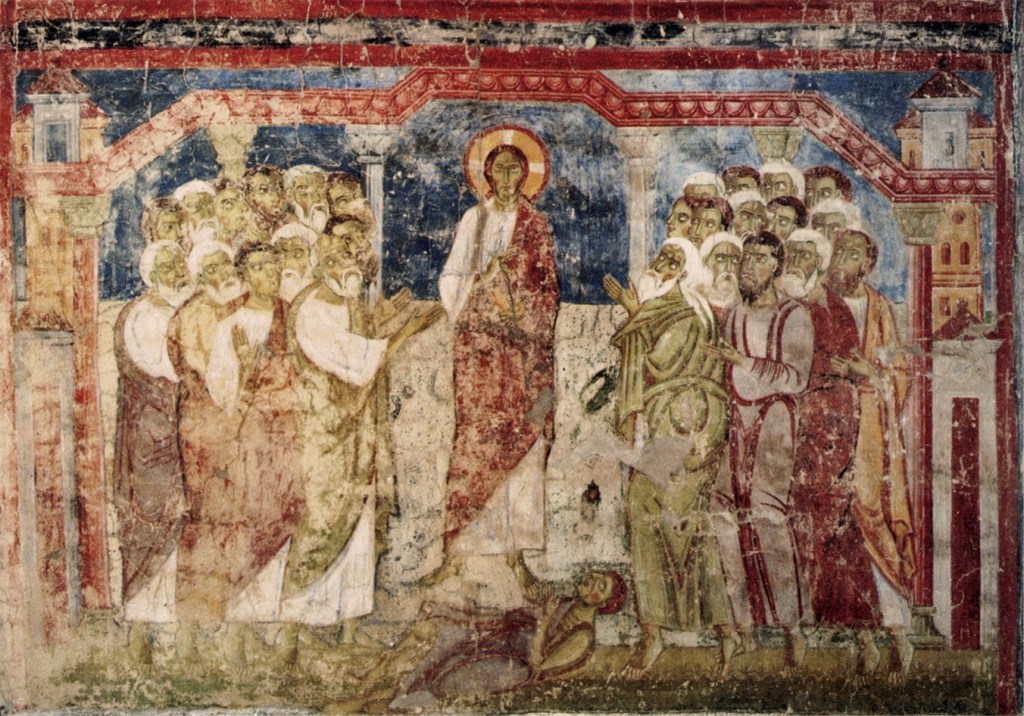
This is the gospel. This is the good announcement that our Emperor–Healer Himself commands us to believe (Mark 1:15). And this good announcement is not merely information about spiritual warfare. It isthe decisive battle — already fought, already won, already declared.
“Since the children share in blood and flesh,” writes the author of Hebrews, “He Himself likewise also shared in these, so that through death He might destroy the one who has the power of death — that is, the devil — and set free those who through all their lives were held in slavery by the fear of death” (Hebrews 2:14–15). And Paul, writing to the Colossians: “Having disarmed the rulers and authorities, He made a public display of them, triumphing over them on the cross” (Colossians 2:15). The language is the language of Roman military triumph — the defeated enemy paraded in humiliation behind the victorious general. The defeated enemy is the devil and his hosts. The victorious general is Christ on His cross.
Every act of spiritual warfare the church engages in — every prayer, every proclamation, every casting out of demonic powers — takes place after and because ofChrist’s victory. We are not soldiers fighting to win a battle whose outcome is uncertain. We are soldiers deployed into territory that has already been conquered, enforcing a victory that has already been declared, gathering plunder — converted human beings — for a King who has already been crowned.
This is where we must begin. Anything less builds on sand.
—–
II. What You Are Because of What He Did
Because of Christ’s perfect obedience, atoning death, justifying resurrection, royal enthronement, inaugurated reign, and gift of the Spirit, something decisive has happened to everyone who is united to Him by faith.
You have forgiveness of sins — not a partial amnesty, not a probationary pardon, but the full and final cancellation of every charge that stood against you in the divine court. The accuser has nothing left to bring against you. The legal ground on which he stood to condemn you has been dissolved by the blood of Christ.
You have justness–righteousness by faith — not the justness you could earn or manufacture, but the perfect justness of Christ Himself, imputed to your account, declared to be yours by the verdict of justification. This is your standing before God: not guilty, but just–righteous. Not merely acquitted, but positively accepted.
You have adoption as God’s child and heir — not a servant’s position, not a citizen’s status, but a child’s inheritance. You are in the family. What belongs to the Father’s firstborn Son now belongs, by inheritance through faith, to you.
You have the Holy Spirit and His power — the same Spirit who raised Christ from the dead now dwells within you (Romans 8:11). The power that defeated death lives in you. This is not metaphor. This is the precise, literal claim of the New Testament.
And therefore: you have victory over Satan. Not victory to be earned. Victory already given. “He who is in you is greater than he who is in the world” (1 John 4:4).
You are, because of all of this, a Spirit-anointed ambassador and witness of our Emperor–Healer. You represent the victorious Commander-in-Chief in enemy-occupied territory. You go not in your own name or strength but in His. You carry not your own message but His good announcement. And the authority with which you act is not the authority of your own spiritual attainment but the authority of the One who said: “All authority in heaven and on earth has been given to Me. Go, therefore….” (Matthew 28:18–19).
To oppressed and persecuted Christians — to communities of believers brutalized by systems that bear demonic fingerprints, to those who feel abandoned and outgunned and overwhelmed by powers too large for any human resistance: this is what you are in Christ. Not victims. Not casualties. Children, daughters, and sons of the King who already won. Bearers of the Spirit who already defeated the powers that are pressing against you. This is not motivational language. This is the declared reality of what God has done for you and given you in His Son.
—–
III. Against Whom We Fight — and What the Plunder Is
Not every sin, error, illness, temptation, or social problem is caused by direct demonic activity; yet all such realities exist within a fallen world in which demonic powers actively oppose God’s purposes.
Paul is unambiguous: “Our struggle is not against blood and flesh, but against the rulers, against the authorities, against the cosmic powers of this darkness, against the spiritual forces of evil in the heavenly places” (Ephesians 6:12).
This does not mean that human beings, human systems, human governments, and human ideologies are irrelevant. It means that behind, beneath, and within the most brutal expressions of human oppression and atrocity, there are spiritual powers at work — principalities and authorities whose agenda is the destruction of human beings made in God’s image, and the obstruction of God’s redemptive purposes in history. When empires enslave, when nations massacre, when systems crush the disadvantaged, when demagogues inflame crowds to murderous contempt — we are not seeing only human evil. We are seeing the operation of “the cosmic powers of this darkness.” The demonic and the structural are not the same thing, but they are not unrelated. This is the application of the biblical principle — not the text’s own direct mapping onto our moment — and history gives us repeated reasons to take that application seriously.
Christ Himself made this framework explicit. When the Pharisees accused Him of casting out demons by the power of Beelzebul, He answered: “How can someone enter the strong man’s house and plunder his possessions unless he first ties up the strong man? Then he can plunder his house” (Matthew 12:29). The “strong man” is Satan. The “plunder” is human beings held captive in his house. The binding of the strong man — accomplished definitively at the cross — is the precondition for the plundering of his house. And the plundering of his house is precisely what happens every time a human being is delivered from darkness and transferred into the kingdom of God’s beloved Son (Colossians 1:13).
This means that the “casting out of demons” is not only the dramatic visible acts of individual deliverance, though it includes those. It is the entire advance of the gospel into enemy territory — every proclamation of Christ’s salvation, every conversion, every community of believers gathered from the nations, every captive set free by the announcement of the good news. “You were dead in your trespasses and sins, in which you once walked according to the course of this world, according to the ruler of the authority of the air” (Ephesians 2:1–2). Salvation isdeliverance from demonic dominion. Every soul who believes Christ’s good announcement is a former prisoner of war now rescued and liberated from the strong man’s house.
The plunder we gather in spiritual warfare is persons. Acts 2:41: “Those who received his word were baptized, and there were added that day about three thousand souls.” Acts 4:4: “Many of those who had heard the word believed, and the number of the people came to be about five thousand.” Pentecost was not only the outpouring of the Spirit. It was a military campaign. Our Emperor–Healer’s newly anointed army proclaimed His gospel to the people of Jerusalem — the city that had just crucified their Commander-in-Chief — and liberated thousands of prisoners of war captive for Him. This is the pattern of kingdom advance throughout the book of Acts. This is the pattern Christians are called to continue until Messiah returns in glory to consummate what He inaugurated.
—–
IV. The Full Armor of God
To fight this war, God has fully equipped His soldiers. Paul’s account of the armor in Ephesians 6:14–17 is not a metaphorical decoration on top of the real content. It is the real content — the precise description of what a believer deployed in spiritual warfare needs to be wearing at all times.
Truth. The belt of truth is what holds everything else together. Satan is “a liar and the father of lies” (John 8:44). His primary weapon is deception — false narratives and false doctrines about God, about humanity, about Christ and His saving work, about who you are, about what is real and what is not. The antidote to demonic deception is not more sophisticated argument. It is the truth of God’s word, worn close, held tight, believed with the whole life. Christians engaging in spiritual warfare must be people of deep, settled, fought-for truthfulness — about Scripture, about themselves, about the world.
Justness–righteousness. The breastplate of justice has two inseparable dimensions. Positionally, it is the righteousness of Christ imputed to the believer in justification — the breastplate that protects the heart from the accuser’s arrows. The accuser’s most powerful weapon against the believer is accusation: you are not just or righteous enough, not holy enough, too compromised, too sinful to be of any use in God’s war. The answer is not to try harder. The answer is to believe and confess that Christ’s own righteousness is counted as yours by faith — and firmly stand in this biblical indicative. Practically, it is the righteousness of sanctification — actual, growing, Spirit-worked conformity to God’s moral character. A soldier whose life contradicts the gospel he proclaims is fighting without God’s breastplate. Personal and corporate holiness is not optional equipment for spiritual warfare. It is essential protective armor.
The good announcement of peace–wellbeing. The gospel of peace is the ground on which Christian soldiers stand. It is also the message they carry — the good announcement that Christ has made peace between God and sinners, that the hostility between heaven and earth has been resolved by His blood shed on the cross for sinners, that “wellbeing” (shalom— the Hebrew wholeness behind the Greek eirēnē) is now available to all who believe in Jesus. Spiritual warfare and gospel proclamation are not two separate activities. The sharing and proclamation of Christ’s good announcement is the primary act of spiritual warfare.
Faith–trust. The shield that extinguishes the fiery arrows of the evil one. Those arrows are not only temptations to sin. They are doubts, fears, despairs, accusations, lies — every weapon the enemy deploys to make the believer waver and/or quit on God. The shield is not willpower. It is faith — active, directed trust in the living God and His promises. When Moses held his hands up, Israel was prevailing (Exodus 17:11). The upraised hands were not magic. They were the visible expression of dependence on God, the posture of trust. When he let them down, the enemy advanced. The lesson is not that spiritual warfare depends on perfect human performance. It is that it depends on sustained, active, corporate reliance on God — which is why Aaron and Hur came alongside Moses and held his arms up until sundown. Christian believers hold one another’s arms up.
Salvation–healing. The helmet protects the mind — the seat of thought, imagination, and identity. The “helmet of salvation” is the settled, secured knowledge of what God has done for us in Christ. A mind not helmeted by salvation is vulnerable to the enemy’s most devastating attacks: attacks on assurance, attacks on identity, attacks on hope. To know that you are saved — that your salvation rests not on your performance but on God’s electing love, Christ’s atoning work, and the Spirit’s sealing — is not a luxury. It is armor.
God’s word — the gospel. The only offensive weapon in the list. “The sword of the Spirit, which is the word of God” (Ephesians 6:17). The word of God, wielded by the Spirit, is the instrument by which the strong man is plundered — by which captives are set free, the blind receive sight, the demonized are set free. Our Emperor–Healer Himself deployed it in His wilderness temptation: not argument, not force, not dramatic display — but the precise, applicable word of God, spoken in faith. We fight with the same weapon — and by the same Spirit who wielded it through Him.
—–
V. The Weapons of Our Warfare — and What They Demolish
Paul returns to the warfare metaphor in his second letter to the Corinthians, and what he says there demands its own attention:
“For though we walk in the flesh, we do not war according to the flesh. For the weapons of our warfare are not fleshly but powerful in God for the demolition of strongholds — demolishing arguments and every high thing raised up against the knowledge of God, and taking every thought captive to the obedience of Christ.” (2 Corinthians 10:3–5)
Three claims press themselves on us here.
First: the warfare is real, but its weapons are not fleshly. Paul does not deny that the Christian soldier walks “in the flesh” — in a mortal body, in a material world, subject to the ordinary conditions of creaturely existence. He denies that this means we fight “according to the flesh.” To war according to the flesh is to fight with the weapons of the old age: deception, domination, coercion, vengeance, violence, manipulative power, and self-protective control. These are the weapons of the strong man’s kingdom. They are not Christ’s weapons. Christians who fight with fleshly weapons — convinced that if they can only secure enough political power, enough cultural dominance, enough legal protection, they will win the war — have not understood which war they are fighting, and whose army they have joined.
Second: our weapons are powerful in God — specifically for the demolition of strongholds. The Greek word translated “powerful in God” (dunata tō theō) is striking: it is not merely “powerful” but powerful with God’s own power, powerful in the way that God is powerful. The weapons the Spirit gives Christians — the gospel, prayer, the word of God, suffering witness, the gathered praise of a redeemed people — do not look powerful by the world’s reckoning. They did not look powerful when Paul was in chains, when the early church was being fed to lions, when the persecuted Christian communities of every subsequent century were praying in secret and dying in public. But they were demolishing strongholds that no army could breach. This has always been true. It remains true now. It will be true until our Emperor–Healer returns.
What are the “strongholds” Paul has in mind? The context of 2 Corinthians 10 makes it clear: he is writing about ideological and intellectual fortresses — “arguments” (logismous) and “every lofty thing that exalts itself against the knowledge of God.” Strongholds are not primarily geographic territories but cognitive and spiritual structures: patterns of thought, worldviews, belief systems, ideological frameworks, and the false narratives and false doctrines through which the enemy holds human minds captive. The principalities and powers do not only destroy bodies. They colonize minds. They build architectures of deception — narratives about who God is (or is not), about who human beings are and are not worth, about Christ’s Person and works, about what is inevitable and what is possible — and they use these architectures to keep persons imprisoned without visible chains.
Every ideology that exalts itself against the knowledge of God is a stronghold. The word Paul uses for “lofty thing” — hypsōma — carries the image of a fortified elevation, a proud structure raised up as a rival throne. It is the posture of every power, institution, ideology, or personal assumption that has installed itself above the knowledge of God and begun to issue commands from that height. This is not only the posture of secular ideologies. It is the posture of any Christianity that has traded the Emperor–Healer’s cruciform kingdom for the strong man’s tools of domination — and called the exchange faithfulness.
Every system of thought that makes Christ’s reign and salvation seem implausible, irrelevant, or harmful is a stronghold. Every lie — personal, cultural, political, religious — that keeps a human being from believing Jesus’ good announcement is a stronghold.
Third: the goal is the taking of every thought captive to the obedience of Christ. The verb Paul uses — aichmalōtizō — is the word for taking prisoners of war. Every thought, every reasoning, every cultural assumption that has been fighting against the knowledge of God is not merely silenced. It is captured, disarmed, and marched in procession behind the victorious general — the same image Paul used in Colossians 2:15 for what Christ did to the demonic powers at the cross. The warfare of the gospel runs in both directions: Christ’s cross captured the powers; the gospel’s advance captures the thoughts those powers colonized. This is the positive content of demolition.
The strongholds are not demolished so that nothing stands in their place. They are demolished so that the knowledge of God — the truth of who Christ is, what He has done, who we are in Him, and what He calls us to — can occupy the space. The warfare of the gospel is not merely negative (tearing down) but positive (capturing and redirecting): every reasoning, every imagination, every cultural narrative and personal assumption brought under the lordship of Christ. This is conversion at its deepest level — not merely a change of religious affiliation but the restructuring of the entire cognitive and spiritual life around a new center. And it is this that the world’s weapons cannot accomplish.
No coercion can produce genuine obedience of mind. No law can take thoughts captive to Christ. Only the Spirit, through the gospel, demolishes from the inside what armies can never reach. And the destination of every captured thought is not merely silence or compliance — it is “the obedience of Christ” (hypakoē tou Christou): participation in the same pattern of perfect, self-giving obedience to the Father that Section I grounds this entire essay in.
The mind that has been liberated from the strong man’s stronghold does not simply become neutral. It is reoriented around a new center — the crucified, risen, reigning Emperor–Healer — and begins to think, reason, and imagine from within His obedience rather than the enemy’s architecture.
This has immediate implications for how Christians understand their mission. We are not primarily a political force trying to capture institutions. We are not primarily a cultural force trying to reclaim aesthetics and symbols. We are a Spirit-wielded demolition crew, sent into the fortressed architecture of human thought and cultural assumption with the gospel as our explosive charge — aimed not at the destruction of human beings but at the liberation of human minds from the strongholds that imprison them. The plunder, again, is persons. And the weapon, again, is the word of God wielded by the Spirit of God in the hands of His people.
The connection to Ephesians 6 is direct: the sword of the Spirit is the same weapon that demolishes strongholds in 2 Corinthians 10. Truth is what stands where the demolished stronghold of the lie once stood. The full armor is not only defensive equipment but the complete kit of a soldier carrying out exactly the campaign Paul describes here — advancing into enemy-held cognitive and spiritual territory, tearing down what the enemy built, and planting the flag of Christ’s lordship and salvation in ground that was once — and will no longer be — held by evil.
—–
VI. The Warfare Strategy of 2 Chronicles 20 — and What It Teaches Us
In 2 Chronicles 20, a vast alliance of Moabite, Ammonite, and Meunite armies advanced against Judah. King Jehoshaphat received the intelligence report. The enemy coalition was already at En Gedi — close, numerous, overwhelming. What did the king do?
He inquired of God (v. 3a). He fasted (v. 3b). He gathered the entire nation — men, women, children, infants — and brought them to stand before YHWH in His house. He prayed, and his prayer was a model of wartime intercession: it began with theology (who God is and what He has done, vv. 6–9), moved to the specific crisis (v. 10–11), confessed the people’s helplessness (v. 12), and ended with an act of complete surrender — “We do not know what to do, but our eyes are on You” (v. 12b). Then the Spirit of YHWH fell on Jahaziel son of Zechariah, and God delivered His word:
“Do not be afraid and do not be dismayed at this great horde, for the battle is not yours but God’s…. You will not need to fight in this battle. Position yourselves, stand, and see the salvation of YHWH who is with you, O Judah and Jerusalem. Do not be afraid and do not be dismayed. Tomorrow go out against them, and YHWH will be with you.” (vv. 15–17)
Jehoshaphat’s response was not to begin tactical planning. He fell with his face to the ground and worshipped (v. 18). The Levites stood up and praised YHWH “with a very loud voice” (v. 19). The next morning, Jehoshaphat appointed singers to go beforethe army, at the front of the battle formation, singing praise to YHWH’s holiness and beauty (v. 21). Not the warriors first. The worshippers.
“And when they began to sing and praise, YHWH set an ambush against the men of Ammon, Moab, and Mount Seir, who had come against Judah, so that they were routed” (v. 22). By the time Judah arrived at the wilderness overlook and looked toward the horde, every enemy soldier was already dead (v. 24). “And Jehoshaphat and his people came to take their plunder, and they found among them, in great numbers, goods, clothing, and precious things, which they took for themselves until they could carry no more. They were three days in taking the plunder, it was so much” (v. 25).
Three days gathering plunder. Three thousand souls at Pentecost. Five thousand more in Acts 4. The pattern holds across the Testaments — not as direct equation but as the consistent shape of how God fights: He acts; His people praise; the enemy falls; the plunder is gathered.
What does this teach us about how we fight?
Faith, praise, and thanksgiving are at the frontline of God’s spiritual warfare strategy for us. Not as mere warm-up to the real work. As the real work. Jehoshaphat’s singers were not a pep rally before the battle. They were the battle formation. They went first because the praise of God’s people is the declaration of His victory — the announcement, in the present tense, of what has already been accomplished in Christ and what YHWH is about to do in the immediate moment.
The key to victory is God fighting for us — not us fighting for God. “You will not need to fight in this battle.” This is not passivism. Jehoshaphat marched. He showed up to the battlefield. He sent his singers to the front. But the fighting was God’s. The enemy’s destruction was God’s. The ambush was God’s. The people’s role was to trust the word, position themselves as commanded, worship with everything they had, and receive the plunder. Every act of spiritual warfare that collapses into human technique, human force, or human strategy — and forgets that the Emperor is Christ, that the decisive battle is already won, that the Spirit is the One who convicts, regenerates, and sets people free — is a soldier trying to do the Commander-in-Chief’s job.
Inquiry, fasting, prayer, and trust are the preparation. Jehoshaphat did not wait for the enemy to arrive at Jerusalem’s walls and then seek God in a panic. He called the nation to seek God as soon as the report came in. The preparation of spiritual warfare — the disciplines of seeking God, fasting, praying, wrestling with His word, trusting His promises — are not peripheral. They are the battlefield conditions that determine everything else. “If you do not stand firm in faith, you will not stand firm at all” (Isaiah 7:9b). Christians who neglect inquiry, fasting, prayer, and trust do not merely fight unprepared. They fight unequipped — and their unpreparedness is itself a victory for the enemy.
—–
VII. To Those Who Are Being Crushed
To the communities most directly in the crosshairs of principalities and powers — to Black, Native, Latine, Palestinian, LGBTQIA+, and other oppressed Christians whose sufferings are not merely social and political but occur within a world in which demonic powers actively work through human sin, injustice, and oppression — I want to say this directly:
The Emperor–Healer has not forgotten you. The battle you are fighting is His battle. The enemy pressing against you is an enemy He has already defeated. The cross is not silent about your suffering. It is the place where every demonic power that controls and drives your oppressors was disarmed, exposed, and publicly humiliated.
This does not mean the suffering is not real. It is real — catastrophically, historically, presently real. It does not mean the systems are not brutal. They are. It does not mean the powers are not dangerous. They still operate, still wound, still kill, even in their defeat — the way a decapitated snake still bites. But they are defeated powers. Their verdict has been rendered. Their end is certain. And the church, gathered from every tribe, language, people, and nation, is the present-tense community that enacts that verdict in the world — through gospel proclamation, through justice, through suffering witness, through the praise of a people who refuse to stop worshipping even when surrounded.
You are not alone in this. You are not outgunned in this. You are fighting under the Emperor–Healer whose resurrection declared the permanent, irrevocable victory of life over death, of righteousness over injustice, of the last Adam’s obedience over the first Adam’s rebellion. The plunder — the harvest of freed persons — is coming. Do not let go of God’s armor and weapons.
—–
VIII. To Those Who Bear Power and Are Complicit in Its Misuse
And to those within the church who hold power, who are aligned with the political structures that are actively crushing the communities described above, who have made their peace with “Christian” nationalism, who have traded the prophetic witness of the gospel for political access and cultural dominance — I want to say this with equal directness:
You cannot cast out demons with the tools of demonic power. You cannot advance the kingdom of God by yoking yourself to the kingdoms of this world. You cannot preach deliverance on Sunday and sign off on the machinery of oppression on Monday, and expect the Holy Spirit’s endorsement of either.
The spiritual warfare framework of Ephesians 6 is not a toolkit for defeating your political opponents. It is a call to put on the full armor of a crucified, risen, reigning Christ — whose kingdom does not come by violence, by deception, by the coercion of the state, or by the suppression of the disadvantaged. When the church aligns itself with power that crushes, it is not wearing the armor. It is fighting for the other side. It may not know it. But the cosmic powers of this darkness know exactly what is happening, and they are pleased.
The call to repentance is urgent. The path back is not complex: humble yourself and inquire of God, fast, pray, confess, stand before Him, and ask Him to fight for you instead of you fighting for yourself. He is merciful. He receives all who come. But the condition for receiving that mercy is the same condition Jehoshaphat met: absolute dependence, complete surrender, and the willingness to let God’s word — not political calculation, not the fear of losing power, not the comfort of complicity — determine the battlefield.
—–
IX. The Practice: How We Fight
Drawing the threads together — from Ephesians 6, 2 Corinthians 10, 2 Chronicles 20, and the whole witness of Scripture — the practice of gospel-centered spiritual warfare looks like this:
Inquire of God and seek Him through His word.Before strategy, before deployment, before any action — go to God. Let His word define the situation, the enemy, the battle, the resources, and the outcome. Not as a preliminary ritual but as the actual first movement of warfare.
Fast. Fasting is the body’s declaration that something matters more than food. In spiritual warfare, it is the physical act of setting aside the ordinary in order to seek the extraordinary — the intervention of God in situations that no human resource can address.
Pray. The model of Jehoshaphat’s prayer is worth inhabiting: begin with who God is, recall what He has done, present the specific crisis honestly, confess your inability, and fix your eyes on Him. Do not perform prayer. Fight with it.
Believe and trust God and His word. This is the hinge on which everything turns. “Believe in YHWH your God, and you will be established; believe His prophets, and you will succeed” (2 Chronicles 20:20b). The promises of God in Christ are not suggestions. They are your grounding and your weapon. Trust them fully. Through them, God drives out Satan and his demons.
Wear the full armor. Not selectively. Not situationally. All of it, all the time. Truth, justness–righteousness, gospel, faith–trust, salvation–healing, the word of God. A soldier who takes off his armor between battles is a soldier preparing to be ambushed. Do not do that.
Demolish strongholds and take thoughts captive.The weapons of our warfare are not fleshly — no coercion, no domination, no violence, no manipulation, no political leverage, no fear. They are powerful in God: the gospel proclaimed, the word of God wielded by the Spirit, prayer, suffering witness, the gathered praise of believers in Jesus. Deploy them without apology and without substitution.
Identify the strongholds. What logismous — what reasonings, worldviews, false narratives, and false doctrines — are holding the people around you captive? What hypsōmata — what proud, self-exalting structures of thought — have installed themselves as rival thrones above the knowledge of God in your minds, your family, your community, your city, your nation? Name them. Not to condemn persons imprisoned in them, but to know precisely what the gospel’s explosive charge is aimed at.
Proclaim Christ’s reign and salvation into them. The sword of the Spirit — the word of God, the good announcement of our Emperor–Healer — is the instrument that demolishes from the inside what no army can breach from the outside. Preach it. Share it. Live it visibly enough that it creates friction with the surrounding architecture of deception. The friction is part of the warfare.
Expect prisoners of war. Aichmalōtizō — the verb Paul uses for “taking captive” — is military language for what happens to enemy combatants after the battle is won. Every thought, every reasoning, every mind that has been fighting against the knowledge of God and is now captured by the gospel is a prisoner of war set free into the obedience of Christ. This is the plunder. Go after it.
Do not fight with the strong man’s weapons to defeat the strong man’s strongholds. Christians who reach for domination, coercion, or political force to advance the kingdom have not understood 2 Corinthians 10:3–5. They are trying to demolish strongholds by becoming one — and they will fail, because only the weapons that are powerful in God can do what only God can do.
Send worship to the front. Let praise and thanksgiving lead. Not after the victory is felt — before it is seen. The singers went out before the army. Jehoshaphat worshipped before he saw the enemy fall. Praise is not the reward for answered prayer. It is the posture of faith that precedes God’s answer and thereby demonstrates — to the watching heavenlies — that we believe our Emperor–Healer has already won.
Gather the plunder. Go to the harvest. The battlefield is also the harvest field. Every person who hears Christ’s good announcement and believes is a prisoner of war liberated from the strong man’s house. This is what the war is for. Not territorial control, not cultural dominance, not the restoration of a “Christendom” that was never as Christian as its defenders claim. The war is for persons — made in God’s image, held captive by the enemy, purchased by Christ’s blood.
—–
X. Prayer
God of all the heavenly armies,
We renounce violence, vengeance, criminality, and hatred of human beings; our struggle is not against blood and flesh.
You have given Your people the armor, the strategy, the promise, and the Emperor–Healer. You have declared the battle Yours and the victory certain. You have told us to stand, to praise, to trust, and to see Your salvation. We believe and trust You. We take You at Your word.
We pray for the U.S. We see the strong man’s work in its fractures — in the machinery of injustice still crushing the poor, still criminalizing the Black, brown, Native, and immigrant, still displacing the disadvantaged for the enrichment of the powerful. We see demonic fingerprints on the systems that call evil good and good evil, that dress cruelty in the language of law and order, that use the name of Christ to consecrate the interests of empire. We name this for what it is: the operation of the cosmic powers of this darkness, and the willful complicity of those who call themselves Christ’s followers while making their peace with it.
We pray, God — judge it. Expose it. Dismantle it. Bring to nothing the counsel of those who plan wickedness in high places. Deliver this nation from the spirit of lawlessness that has wrapped itself in the flag and called itself “Christian” — and deliver Your church from the cowardice that has allowed it. Bring to justice those who have used power as a weapon against the weak. And rebuild — not a restoration of what was, which was never just, but a genuine reconstruction: communities restored, dignity returned, the captives set free.
We pray for Your persecuted and suffering people everywhere. For the communities decimated by violence, displacement, dispossession — in this nation and across the earth. Fight for them, as You fought for Jehoshaphat. Let them position themselves, stand, and see Your salvation. Let the plunder that comes from their suffering witness be beyond what three days can gather.
We share Christ, proclaim His gospel in word and action, demolish strongholds by exposing lies and speaking truth, and, by the power of the Spirit, drive out evil spiritual powers in Christ’s name.
Holy Spirit, use us — broken, insufficient, imperfect as we are — to manifest Christ’s kingdom and accomplish God’s will in the United States and worldwide, “as it is in heaven.”
— Matthew 6:10
Holy Spirit of Emperor–Healer Jesus Christ, be merciful to us, anoint us, lead us, and help us.
—–
Glem Melo is an imperfect, repentant evangelical missionary.
With AI research and composition assistance.

