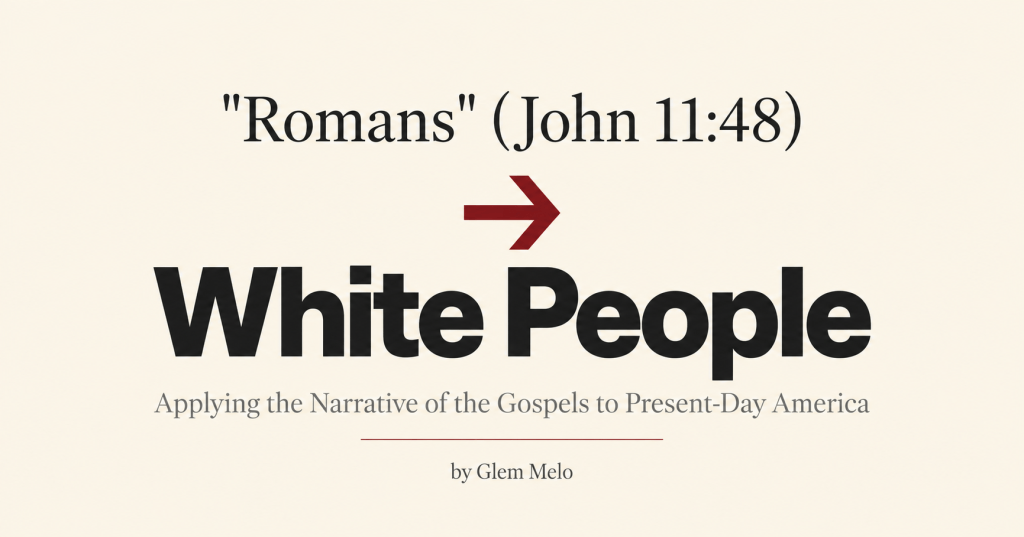
Applying the Narrative of the Gospels to Present-Day America
After Jesus raised Lazarus, many believed. Others went and told the Pharisees. So the chief priests and Pharisees convened the council: “If we let him go on like this, everyone will believe in him, and the Romans will come and take away both our place and our nation” (John 11:48). Caiaphas, high priest that year, said it was better that one man die than the whole nation perish. John does not leave that sentence to stand as mere political calculation. He tells us Caiaphas unwittingly prophesied — that Jesus would die for the nation, and not for the nation only, but to gather into one the scattered children of God (11:51-52). Fear of empire produced a plot against the Messiah. The Messiah’s death produced, instead, a gathered people.
That gathering is the lens for what follows. The arrows below are not equations of ancient ethnicity with modern race; they are analogies of social role — imperial power, subjected people, religious leaders who legitimize violence, domination, and theft, and those gathered in from outside — read into the American story:
Romans → white people.
Chief priests, Pharisees, Sadducees, and scribes → genocider-thief, Confederacy, lyncher, apartheider, MAGA pastors and teachers.
Jews → our Foundational Black American, Native American, and U.S.-native Mexican siblings.
Gentiles, nations → all immigrants, including white people.
A note on the words themselves: John 11:48 uses ἔθνος — “nation” — for Israel, not for outsiders. The term is not fixed; it names a people by context, not a fixed side. “All immigrants, including white people” is this essay’s own application of that flexibility — not a translation. And chief priests, Pharisees, Sadducees, and scribes were not one bloc: they had different roles, different relationships to Rome, and different responses to Jesus. John 11:47 itself names only chief priests and Pharisees convening the council; the mapping below is a contemporary analogical target, not a claim that all four ancient groups collaborated identically with Rome. Naming today’s genocider, Confederate, lyncher, apartheider, and MAGA pastors and teachers targets a pattern of legitimizing violence, domination, and theft — not an ethnicity, then or now.
No single actor bears sole responsibility for Jesus’ crucifixion. He was handed over by the chief priests, condemned under Pilate’s Roman authority, and executed by Roman soldiers. But Rome did not have the last word.
Jesus is the crucified, risen, and already reigning Messiah. His kingdom belongs to His repentant believers–followers. In Him there is forgiveness, salvation, liberation, healing, restoration, renewal, purpose, hope, nurture, equipping, and empowerment. Believe. Unite with Jesus by trusting Him. Embrace the truth, reality, hope, and empire that His gospel, His good announcement, proclaims.
Receive the Holy Spirit and be clothed with His enabling power.
Be Jesus’ ekklesia. John says Jesus would die to gather into one the scattered children of God (11:52). In Matthew, Jesus makes a related promise: He will build His own ekklesia (Matthew 16:18). Read together, the two Gospels point toward one gathered, named people. Become the people He is gathering to Himself. Endure and persevere in following and serving Him and His gospel, despite tribulations and persecutions. Be dead people walking: deny yourself, take up your cross, follow Him, lose your life for His sake to find it (Matthew 16:24-25). This is not despair. Matthew ties this self-denial directly to what comes after: the Son of Man will repay each person according to what they have done (Matthew 16:27). The self-denial and cross-bearing Jesus asks for are not an ending but the condition of following Him.
As dead people walking, love and serve one another. Love and bless your enemies. Share Jesus and disciple all the ethnē. Heal the sick and drive out evil spirits — first as Jesus’ own disciples did, evicting the unclean spirits that bound real people, and only then as a pattern for confronting the evils, personal and structural, that still bind.
Jesus will raise up His believers–followers on the last day (John 6:39-40) and reward each one for what they have done (Matthew 16:27). His authority is total — all authority in heaven and on earth belongs to Him (Matthew 28:18) — and His work is total reconstruction, the renewal of all things, when the Son of Man sits on His glorious throne (Matthew 19:28). But divine judgment and wrath are coming upon all who continue to rebel and reject Him (Matthew 3:7; John 3:36; John 5:22-29; Matthew 25:31-46) — not a promise for the oppressed and a warning for the powerful alone, but one gospel summons to everyone: repent, believe, and be gathered into the one people Jesus is building — whatever place any of us occupies in the analogy named above.
“A little while, and the evil person will be no more;
though you look carefully at their place,
they will be no more.
But the humble will inherit the earth
and enjoy abundance of well-being.”
— Psalm 37:10–11 (translation mine)
—
#TruthIsEssential
#EverybodyRepent
—
Holy Spirit of Emperor–Reconstructor Jesus Messiah, please be merciful to us and heal us.
—
Glem Melo is an imperfect but repentant evangelical missionary.
With research and composition assistance from AI tools.

