External enemies exploit internal weakness. A truly secure USA must be rebuilt from within — then strengthened outward.
At a Glance
- China, Russia, Iran, and North Korea pose real threats, but panic and authoritarian politics would make the United States weaker, not stronger.
- External enemies exploit internal weakness; therefore, internal reconstruction is not a distraction from national security but a condition of it.
- The current crisis is military and geopolitical, but also moral, constitutional, racial, economic, and spiritual.
- A truly secure USA requires constitutional accountability, racial repair, material well-being, lawful public safety, resilient infrastructure, credible deterrence, and accountable power together.
- The goal is a nation harder to divide, harder to corrupt, and harder to defeat.
⸻
My U.S. Situational Discernment (So Far)
“And you will turn and see the difference between the just and the evil, between the one who serves God and the one who does not serve Him.”
— Malachi 3:18 (translation mine)¹
In Jesus, the Day of YHWH — His reign, His kingdom — has already begun. It is not yet manifested in its consummate fullness and perfection. That awaits Christ’s second coming. Nevertheless, even just in its inaugurated manifestation, it is certainly full of grace and power.²
⸻
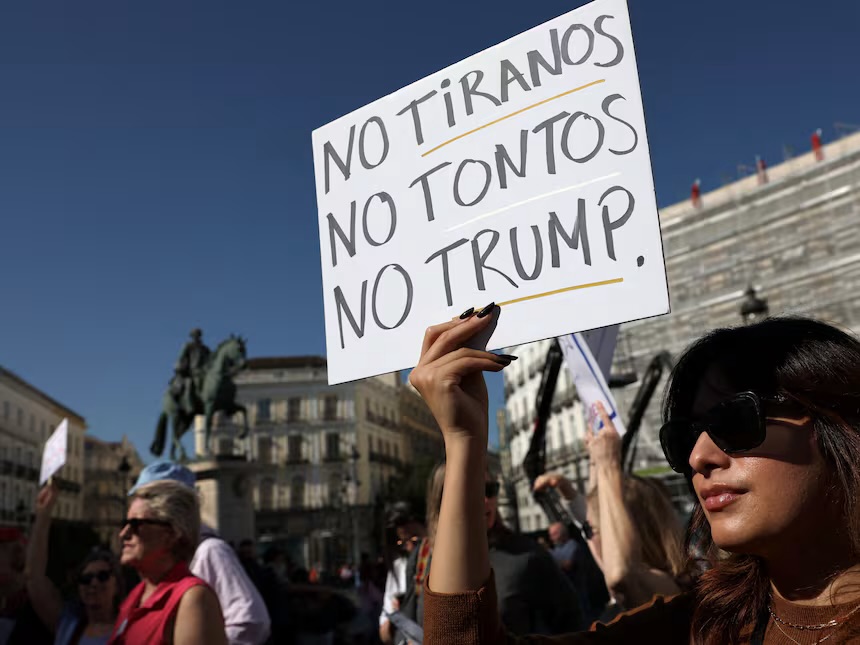
The intransigent, systemic-structural wickedness of Trump, MAGA, and their supporter-enablers is a form of God’s judgment against them (Romans 1:18–32). They are like Pharaoh (Romans 9:17–18).³
Christ calls us to pray for and witness to them. The way of mercy and salvation continues to be open to all.
⸻
Effective prayer and witness require spiritual discernment. Therefore, we need the Holy Spirit.
⸻
The Spirit gives His supernatural gifts to Christians who live in repentance and faith.⁴
As we repent and meditate on Scripture, the Spirit cleanses and purifies our minds. He is like fire.
With a Spirit-renewed mind, we are enabled to discern things more clearly and more accurately. At the same time, we become more receptive and appropriately responsive to His supernatural gifts — word of knowledge, word of wisdom, prophecy, discernment of spirits, dreams, visions, and so on.
⸻
I am not claiming that all or any of the following statements are from the Holy Spirit. Perhaps none or only some of them are. They are, without doubt, flawed attempts at discernment from an imperfect believer in Jesus. Reader discretion and wisdom are encouraged.
⸻
I can be wrong about some, many, or most of the things that I say, write, and do. But obligated by God, trusting in Christ’s blood and free gift of justification, relying on the presence and power of the Holy Spirit, and compelled by His love for His church and all humanity, I cannot be silent or cower in paralyzing fear. I have to speak.
⸻
I use “White” in quotation marks when referring to whiteness as a constructed social identity and power formation, not as a biblical peoplehood.⁵
⸻
Not all white people are “White.”
⸻
As a pastoral-political observation — one I hold with conviction but not with the certainty of hard data — a large and, in my assessment, socially consequential portion of white persons in the U.S. appear to function within “White” identity and power structures, whether consciously or not. Sociological research on implicit bias, residential segregation, and racial wealth gaps lends circumstantial weight to this observation.⁶ Federal Reserve data from 2022 show that the typical Black family held 15.75% of the median wealth of the typical white family, and the typical Hispanic family held 21.62% — figures consistent with structural inequality accumulated across generations, even though this dataset by itself does not isolate causation.⁷
Oppressed communities are therefore justified in exercising serious and sustained caution, and encouraged to endure and persevere in their fight for freedom, justice, and equality.
⸻
The United States has functioned through structures of imperialist, white supremacist, predatory capitalist, patriarchal oligarchy — and continues to do so.
⸻
Either overtly or covertly, too many white persons in the U.S. function — whether consciously or not — within structures of occupation and conquest. They are “White.”
⸻
“White” identity is inherently conservative — not merely in a partisan sense, but structurally: it conserves occupation, control, and racialized advantage. To be “White,” in the sense I am using the term, is precisely to resist any redistribution of that power. This is not a claim about skin color; it is a claim about a structural posture toward power.
⸻
Right now, the Republican electorate is approximately 79% non-Hispanic white, and white conservative identity remains central to the party’s present coalition and political machinery.⁸ Although that coalition is the dominant force in Republican politics, I would like to believe that — though likely small in number — there are white Republicans who refuse to identify or function as “White” persons.
⸻
Too many white Democrats and white independents are covertly “White” — or at the very least, suspiciously so. See, for example, Clinton-era policies with racially damaging consequences — the 1994 Crime Bill⁹ and the 1996 Welfare Reform Act;¹⁰ and Bernie Sanders’ still-contested “yes” vote on the former.¹¹
Conquistadorial occupiers — those who operate with the spirit of conquest and colonial domination — in liberal and/or progressive clothing do exist. And on this matter, the burden of moral demonstration is with white liberals and progressives: not merely to profess equality, but to show through policy, accountability, and redistribution of power that they are not simply managing white dominance in progressive form.
⸻
It seems to me — and I may be dead wrong about this — that the “White” conquistadores exert decisive influence over both the Republican and the Democratic parties. Direct evidence of coordinated control is not public. But circumstantial patterns — bipartisan support for the 1994 Crime Bill, insufficient bipartisan action on the racial wealth gap, and bipartisan deference to military and financial interests — warrant the suspicion. I offer it as hypothesis, not verdict, and invite refutation by policy, not rhetoric.
The burden of moral demonstration is with white Democrats.
⸻
Fears that, if the Trumpist dictatorship setup fails, this current socio-political swing to the extreme, fascistic right will produce a swing to the opposite direction — toward what some describe as the extreme, communist left — are understandable and worth processing seriously. However, it must be noted that “communist” is largely a rhetorical label deployed to discredit any robust challenge to concentrated power. The realistic concern is not communism but a sharp, populist leftward reaction — one that freedom advocates should neither fear nor suppress, but rather engage, shape, and anchor in genuine justice.
Or perhaps such expressed fears carry significant warnings that we all need to process and prepare for. This current socio-political swing to the extreme, fascistic right could really produce a sharp swing toward the extreme left.
Again, the burden of moral demonstration is with liberals and progressives.
⸻
All of these are happening while external threats continue — and while the current U.S. administration is persistently inflicting multiple forms of severe, systemic damage to the nation, which, one may fairly infer, benefits our adversaries.¹²
Bottom line: All Black, Native, Latine, and other freedom advocates, activists, allies, and supporters must unite and work together for the cause of true, just, and equitable national security and well-being — whether or not conservatives change course and stop supporting or enabling a nation-damaging, adversary-advantaging president, and whether or not white liberals and progressives prove that they are not “White.”
⸻
On Threats: External, Internal, and Their Relationship
When many of us think about national security, we think first — and understandably — about China and Russia. That instinct deserves a direct and honest answer, grounded in documented evidence rather than either reassurance or panic.
How serious are the external threats?
Serious — but not in a way that justifies panic, and not in a way that justifies authoritarian politics.
The 2026 ODNI Annual Threat Assessment identifies China, Russia, Iran, and North Korea as viewing the United States as a strategic competitor and potential adversary.¹³
China is the most comprehensive long-term strategic competitor across military, cyber, technological, industrial, economic, and space domains. The Pentagon’s 2025 annual report to Congress documents that China’s military has drawn specific lessons from the Russia-Ukraine war relevant to a potential Taiwan conflict — including the need for modern weapons systems, nuclear-deterrent expansion, true joint-force development, improved logistics, autonomous platforms, distributed satellite communications, urban warfare preparedness, and information control.¹⁴ China is not standing still. It is studying, adapting, and building.
Russia is a different kind of threat — not as economically or industrially comprehensive as China, but dangerous in its own right. Despite significant conventional losses in Ukraine, Russia retains the world’s largest nuclear arsenal, intact air and naval forces, advanced cyber capabilities, and a demonstrated willingness to use military force against neighboring nations. The Office of the Director of National Intelligence (ODNI) identifies the most dangerous Russia-related scenario as escalation from Ukraine or another flashpoint into direct hostilities with the United States or its allies — including nuclear exchanges.¹⁵
North Korea adds nuclear, missile, and cyber risks to the threat environment. Iran adds missile, proxy, cyber, regional-instability, and nuclear-latency/WMD-related risks — including ongoing efforts to recover from damage to its nuclear infrastructure.¹⁶
The coalition dimension is real but must be stated precisely. The 2026 ODNI assessment finds that China, Russia, North Korea, and Iran are not a fully unified war bloc. Their cooperation is selective, primarily bilateral, and constrained by divergent interests and by each party’s caution about direct confrontation with the United States. Nevertheless, that selective cooperation is meaningfully increasing the threat each poses individually, and the trend is toward deeper coordination, not less.¹⁷
Could the U.S. prevent or defeat a joint invasion?
The question must be framed carefully, because “joint invasion” can mean very different things — and the distinction matters.
A conventional land-and-sea invasion of the continental United States is not the primary documented threat. The United States retains major geographic advantages, a secure nuclear deterrent, powerful conventional and special operations forces, advanced intelligence capabilities, and a network of treaty alliances that no adversary coalition currently matches. ODNI states that the U.S. nuclear deterrent continues to ensure homeland safety.¹⁸
The realistic danger is different in character: a coordinated or opportunistic multi-domain crisis — simultaneous or sequential cyberattacks on power grids, water systems, financial networks, and communications infrastructure; missile coercion; attacks on satellites and space assets; disinformation campaigns designed to deepen domestic division; supply-chain disruption of critical goods; sustained military pressure on Taiwan; continued escalation in Ukraine; North Korean nuclear and missile coercion; and Iran-linked regional conflict drawing on U.S. resources and attention. That kind of compounding, multi-theater pressure is what the documented threat environment actually describes. And against that kind of pressure, U.S. preparedness is genuinely in question.
What comfort — and what lack of comfort — does the documented data provide?
The comfort is real and should be stated plainly. The United States remains enormously powerful. Its nuclear deterrent continues to provide a documented baseline of homeland protection. ODNI assesses that China is not currently planning a Taiwan invasion on any fixed timeline and continues to prefer unification without force if achievable.¹⁸ The 2026 National Defense Strategy states that the United States and its allies, if properly invested and coordinated, can generate sufficient combined force to deter adversaries even if they act concurrently across multiple theaters.¹⁹
The warnings are equally real and should not be minimized. ODNI projects that adversary missile arsenals capable of striking the U.S. homeland could grow from more than 3,000 today to more than 16,000 by 2035, as China, Russia, and North Korea continue developing advanced delivery systems. Cyber adversaries have already pre-positioned capabilities for disruptive and destructive attacks against U.S. critical infrastructure.²⁰ The 2026 National Defense Strategy itself names rebuilding the defense industrial base as a top-four strategic priority — an implicit acknowledgment that the United States cannot sustain its own defense commitments without first rebuilding the institutional and industrial foundations that make deterrence credible.¹⁹
The Heritage Foundation’s 2026 Index of U.S. Military Strength — an influential, detailed conservative defense assessment that does not speak for the government but commands serious attention in defense policy circles — rates the overall U.S. military posture as “marginal,” with the Navy, Air Force, Coast Guard, and Merchant Marine rated “weak.” Its conclusion is specific: the current force is at significant risk of being unable to meet a two-major-regional-contingency benchmark; it would probably not be able to carry out successful operations beyond a single major regional contingency against a peer competitor such as China, and is ill-equipped for two nearly simultaneous major regional conflicts.²¹ Heritage also assesses, in its own evaluation, that in space China and Russia are fielding ground- and space-based threats to U.S. assets that currently outpace the Space Force’s efforts to develop resilient defensive capabilities.²²
The conclusion the data requires
Americans should not be comforted into complacency or frightened into authoritarianism. The documented record gives both reassurance and warning: the United States remains powerful, but it is not secure enough to withstand great-power pressure while its constitutional order, industrial base, cyber defenses, civic trust, and material foundations are being hollowed out.²³,²⁴
A nation that is constitutionally deteriorating, oligarchically captured, racially wounded, economically precarious, and civically fragmented is easier for every adversary to exploit — through disinformation that amplifies domestic division, through economic coercion of a population without material security, through political manipulation of institutions weakened by authoritarian consolidation, and through the exploitation of a civic culture that no longer trusts itself. External adversaries do not merely attack from outside. They also invest in internal weakness.
Therefore, internal reconstruction is not a distraction from national security. It is a condition of national security. The external and internal threats must be addressed together — and they must be addressed honestly, without allowing either to become an excuse for ignoring the other.
The United States must deter China and Russia, harden cyber and critical infrastructure, strengthen alliances, protect supply chains, and maintain lawful defense readiness. At the same time, it must restore constitutional accountability, weaken oligarchic capture, repair racial injustice, protect democratic participation, and secure the material well-being of its people.
The danger is not that Americans take China and Russia seriously. The danger is that external enemies are used to excuse internal injustice — as they have been, historically, to suppress dissent, justify domestic militarization, and redirect public attention from racial, economic, and constitutional accountability.
True security is not achieved by projecting power abroad while the republic decays within.
True security is constitutional integrity, racial repair, lawful public safety, material well-being, resilient infrastructure, credible deterrence, and accountable power — together.
China and Russia are real threats. But a lawless, oligarchic, racially wounded, materially insecure, and civically fragmented United States is easier for every adversary to exploit. Therefore, the first requirement of national security is not panic abroad, but reconstruction at home — constitutional, moral, racial, economic, and spiritual.
A nation ordered toward justice is harder to divide, harder to corrupt, and harder to defeat.
⸻
Reconstruction as Alliance Strength and Witness to the Nations
What is true internally is also true internationally. The condition of the United States at home directly shapes what it can inspire, build, and sustain abroad.
Alliances are not merely transactional arrangements — treaties signed, bases shared, budgets pooled. They are relationships sustained by trust, and trust is sustained by credibility. A United States that honors its constitutional order, protects civil rights, holds power accountable, and demonstrates that democratic self-government can still work is a more trustworthy ally. A United States that is visibly deteriorating — whose courts are pressured, whose elections are contested, whose agencies are politicized or dismantled, and whose commitments shift with each administration — gives allies reason for strategic adjustment. European democracies have accelerated defense investments because of Russia’s aggression, the changing threat environment, and growing concern that U.S. commitments may not be as automatic as they once seemed.²⁵ It is reasonable to infer that Indo-Pacific partners are watching both Taiwan policy and Washington’s institutional stability. Allies do not merely count missiles. They measure credibility. Constitutional integrity is therefore alliance policy.
Internal reconstruction also weakens authoritarian propaganda. China is not simply the Chinese Communist Party. Russia is not simply Vladimir Putin. Iran is not simply its current theocratic regime. North Korea is not simply Kim Jong-un. Every adversary nation contains people made in the image of God — many of whom suffer under their own government’s injustices and atrocities, and some of whom are working, at great personal cost, for accountability and reform. The same Christ who is Lord over Washington is Lord over Beijing, Moscow, Tehran, and Pyongyang. His reign does not stop at the borders of nations that currently oppose it. A United States that practices constitutional accountability, racial repair, material security, and lawful public power removes ideological ammunition from authoritarian regimes that point to American hypocrisy, oligarchy, and racial domination as proof that democracy does not work. That propaganda is currently credible.¹² Internal reconstruction makes it less so.
This is not naïveté. China’s military buildup, Russia’s war against Ukraine, North Korea’s nuclear program, and Iran’s proxy networks are real and must be deterred, contained, and opposed through every lawful and effective means. Deterrence and justice are not alternatives. They are complements. The question is not whether to maintain strong defenses — it is whether those defenses rest on a foundation strong enough to sustain them, and whether the nation wielding them has the moral authority to lead.
For the coming years, the top priority for national security is not new weapons platforms alone, but also the rebuilding of constitutional, democratic, and justice foundations at home — because without that foundation, no defense posture is durable, no alliance is fully reliable, and no claim to international leadership is fully credible.²³,²⁴
In Christ, justice and security are not enemies. Psalm 85:10 says it plainly: “Righteousness and peace have kissed each other.” A nation ordered toward justice is harder to divide, harder to corrupt, and harder to defeat. And reconstruction at home is, finally, a form of witness to the world — including to the nations that are currently our adversaries.
⸻
Glem Melo is an imperfect, repentant evangelical missionary.
⸻
With research and composition assistance from multiple AI tools.
⸻
Endnotes
1. Malachi 3:18 translation. Translation mine from the Hebrew sense of returning/turning and seeing/discerning the distinction between the righteous/just and the wicked/evil, and between the one serving God and the one not serving Him. Compare standard English translations of Malachi 3:18.
2. Inaugurated kingdom / Day of YHWH framing.The theological claim that God’s reign has already broken into history in Christ, while awaiting consummate fullness at His return, reflects the “already/not yet” structure commonly drawn from texts such as Mark 1:14–15; Acts 2:14–36; 1 Corinthians 15:20–28; Hebrews 2:8–9; and Revelation 11:15.
3. Romans 1 and Pharaoh analogy. The judgment/hardening framework draws from Romans 1:18–32 and Romans 9:17–18. The essay’s application to contemporary political actors is the author’s theological discernment, not a claim that Paul names those actors directly.
4. Holy Spirit and gifts. The references to Spirit-enabled discernment and supernatural gifts draw from texts such as Acts 2; Romans 12:3–8; 1 Corinthians 12–14; Ephesians 4:11–16; 1 Thessalonians 5:19–22; and 1 John 4:1.
5. Use of “White.” In this essay, “White” is the author’s analytic and pastoral-political category for whiteness as a constructed social identity and power formation, not a biological peoplehood or a claim about every person socially classified as white. The distinction is internal to the essay’s argument.
6. Implicit bias, residential segregation, and structural racism. For background on implicit bias in relation to structural racism, see National Academies discussions of how structural racism and implicit bias can reinforce each other. For residential segregation, see the U.S. Census Bureau working paper Metropolitan Segregation: No Breakthrough in Sight, which reports high but slowly declining Black-white segregation and less intense but persistent segregation of Hispanics and Asians from whites. The essay uses these sources as circumstantial support for structural inequality, not as proof of individual motive.
7. Racial wealth gap. Federal Reserve researchers using the 2022 Survey of Consumer Finances report persistent racial wealth gaps. In 2022, the typical Black family had 15.75% of the median wealth of the typical white family, and the typical Hispanic family had 21.62%. The same Federal Reserve note summarizes the gap as the typical white family having about six times the wealth of the typical Black family and about five times the wealth of the typical Hispanic family.
8. Republican electorate demographics. Pew Research Center reported in 2024 that about 79% of Republican voters were non-Hispanic white, down from 93% nearly two decades earlier, and that Hispanic, Black, and Asian voters together made up a much smaller share of Republican voters than Democratic voters, 15% vs. 39%.
9. Brennan Center for Justice, “The 1994 Crime Bill and Beyond: How Federal Funding Shapes the Criminal Justice System,” September 9, 2019. The report notes that the law’s legacy is complicated: some provisions protected communities and victims — including the Violence Against Women Act and an assault-weapons ban — while funding incentives widened the criminal justice net. The essay’s phrase “racially damaging consequences” is an evaluative summary of the bill’s criticized effects, not a claim that every provision had the same character.
10. 1996 Welfare Reform Act. The Personal Responsibility and Work Opportunity Reconciliation Act of 1996 was signed by President Bill Clinton. HHS describes the law as imposing work requirements and other restrictions, including work after two years on assistance, with limited exceptions.
11. Bernie Sanders’ 1994 Crime Bill vote. PolitiFact confirms that Bernie Sanders voted for the 1994 crime bill and later defended the vote by pointing to provisions he supported, while critics have argued the law helped fuel mass incarceration and harmed Black communities.
12. Trump administration damage to national security, democratic health, and household security. For the author’s fuller argument, see Glem Melo, “Is Trump Putin’s Puppet — or Something Worse? On Trump, Putin, Xi, and the Weakening of America,” GlemMelo.com, April 26, 2026, revised April 29, 2026, https://glemmelo.com/2026/04/26/trumpputinpuppet-3/. That essay explicitly states that there is no hard proof that Donald Trump is operationally controlled by Vladimir Putin, but argues that a documented pattern across Helsinki, NATO, Ukraine, Iran, tariffs, federal capacity, and democratic institutions weakens American power, credibility, democratic health, and household security in ways that benefit U.S. adversaries. Key domestic data points include a Yale Budget Lab estimate that the administration’s tariff regime represented a $1,700 loss for the average American household, and reporting that more than 10,000 doctoral-trained scientists and experts in STEM and health fields left federal positions in 2025. The present essay uses that claim as a reasoned inference from patterns and consequences, not as an allegation of proven foreign control. Independent indicators support the broader concern: Freedom House reported that the U.S. score fell from 84 to 81 in its 2026 report — the sharpest decline among countries rated “Free” — and Reuters reported that the 2026 Democracy Perception Index found global perceptions of the U.S. falling below perceptions of Russia amid concerns over Trump’s foreign policies, tariffs, NATO strains, Ukraine aid, and the Iran war.
13. 2026 ODNI Annual Threat Assessment: strategic adversaries. The 2026 Annual Threat Assessment from the Office of the Director of National Intelligence identifies China, Russia, Iran, and North Korea as states that view the United States as a strategic competitor and potential adversary.
14. China military modernization and Ukraine-war lessons. The Pentagon’s 2025 annual report to Congress on China states that the People’s Liberation Army has studied lessons from the Russia-Ukraine war relevant to Taiwan and broader military modernization, including modern weapons, protracted conflict, nuclear-deterrent expansion, joint-force development, logistics, autonomous platforms, distributed satellite communications, urban warfare, and information control.
15. Russia threat and escalation risk. ODNI’s 2026 assessment identifies Russia as a serious military, nuclear, cyber, and intelligence threat, and describes escalation from Ukraine or another flashpoint into direct hostilities with the United States or its allies — including possible nuclear exchanges — as the most dangerous Russia-related scenario.
16. North Korea, Iran, and WMD-related risk.ODNI’s 2026 assessment describes North Korea’s nuclear, missile, and cyber threats, and identifies Iran’s missile, proxy, cyber, regional-instability, and WMD-related risks. The essay’s phrase “nuclear-latency/WMD-related risks” is intended to avoid implying that Iran currently possesses a nuclear arsenal.
17. China-Russia-Iran-North Korea cooperation.ODNI’s 2026 assessment describes selective cooperation among China, Russia, Iran, and North Korea as increasing the threat each poses, while also noting that their alignment remains limited, mostly bilateral or situational, and constrained by divergent interests and caution about direct confrontation with the United States.
18. Taiwan invasion timeline and U.S. nuclear deterrent. ODNI assesses that China continues developing capabilities to seize Taiwan if directed, but does not currently have a fixed timeline for unification or a current plan to invade Taiwan in 2027. ODNI also states that the U.S. nuclear deterrent continues to ensure homeland safety.
19. 2026 National Defense Strategy. The 2026 National Defense Strategy lists four major priorities: defending the U.S. homeland, deterring China, increasing allied burden-sharing, and rebuilding or “supercharging” the U.S. defense industrial base. The essay treats the NDS as an official strategic document, not as a neutral moral authority.
20. Missile threat growth and cyber pre-positioning. ODNI projects that missile threats to the U.S. homeland could expand from more than 3,000 missiles today to more than 16,000 by 2035, while also warning that cyber adversaries can pre-position or execute disruptive and destructive attacks against U.S. critical infrastructure.
21. Heritage Foundation 2026 Index of U.S. Military Strength. Heritage’s 2026 Index is an influential conservative assessment, not an official government assessment. It rates the overall U.S. military posture as “marginal,” rates the Navy, Air Force, Coast Guard, and Merchant Marine as “weak,” and concludes that the current force is at significant risk of being unable to meet a two-major-regional-contingency benchmark.
22. Heritage on Space Force and space threats.Heritage’s 2026 Index also assesses that China and Russia are fielding ground-based and space-based threats to U.S. space assets that outpace the Space Force’s efforts to develop resilient architectures and defensive capabilities. This is Heritage’s assessment, not an ODNI or DoD finding as phrased in the essay.
23. Defense industrial base constraints. The National Defense Industrial Association’s Vital Signs 2026 report describes improvement in defense industrial readiness but continuing constraints, including budget instability, compliance burdens, unclear demand signals, and other barriers limiting industrial participation and capacity.
24. V-Dem democracy decline. V-Dem’s 2026 Democracy Report states that the U.S. Liberal Democracy Index declined by 24% in one year and that the U.S. ranking dropped from 20th to 51st out of 179 countries. This source supports the broader claim that democratic deterioration is not merely a domestic civil-liberties issue but also a strategic vulnerability.
25. NATO defense spending and allied burden-sharing. NATO reported in 2026 that European Allies and Canada increased defense spending by 20% compared with 2024. The essay’s language about allied “strategic adjustment” interprets this spending increase in the broader context of Russia’s aggression, a changing security environment, and concern that U.S. commitments may be less automatic than before.

