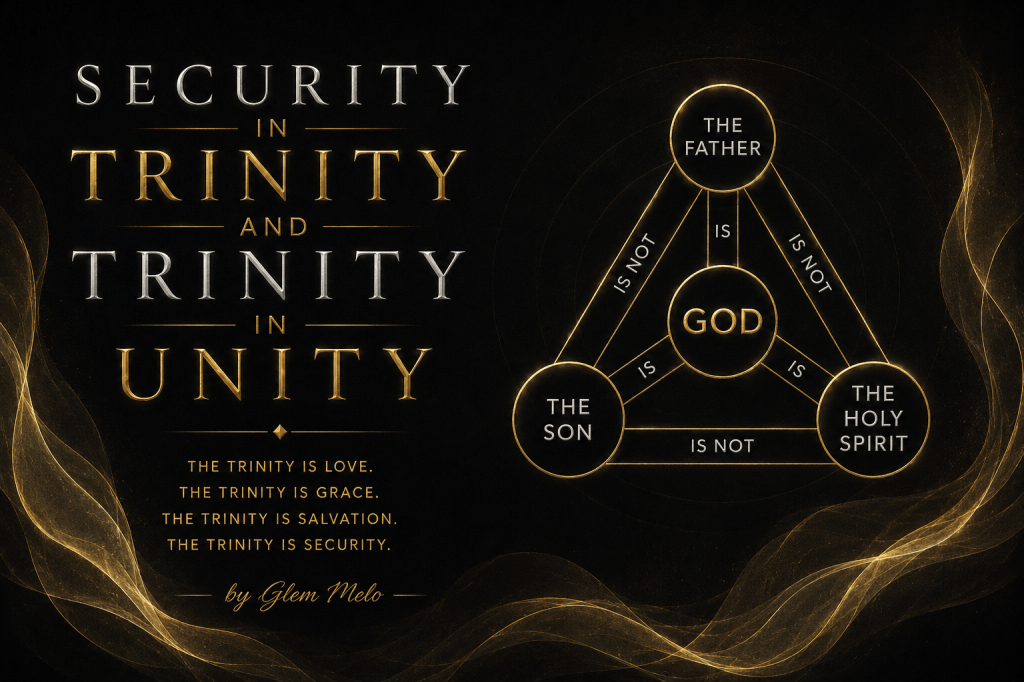
The Trinity is love, grace, salvation, and security.
—–
There is a question that haunts the conscience of the believer — not always voiced, but felt: Can I be lost?It surfaces in the aftermath of grievous sin, in seasons of spiritual dryness, in the cold hour of the night when the soul turns inward and finds not the warmth of assurance but the chill of doubt. Is my faith real? Have I gone too far? Has God’s patience with me finally run out?
The answer the Scriptures give is not a therapeutic word of comfort divorced from theological ground. It is not a reassurance built on the shifting foundation of the believer’s own faithfulness, spiritual performance, or emotional experience. The answer is Trinitarian. It is grounded in who God is — Father, Son, and Holy Spirit — and in what God in Trinity has sovereignly, graciously, and irrevocably done for and in His own. The eternal security of the believer is, at its root, the eternal security guaranteed and effectuated by our triune God Himself: one God in Trinity, and Trinity in Unity.
—–
I. The Son: The Infinite and Eternally Effectual Redeemer
We begin where the believer’s assurance must always return — to the Person and work of the Lord Jesus Christ, the Son of God incarnate, perfectly just and righteous, crucified, risen, and reigning (1 Corinthians 15:3–8).
In John 10:27–29, the Savior speaks with an authority that belongs only to God:
“My sheep hear my voice, I know them, and they follow Me. I give them eternal life, and they will never perish. No one will snatch them out of My Hand. My Father, who has given them to Me, is greater than all, and no one is able to snatch them out of the Father’s Hand.”
Note the architecture of this passage with care. The security of the sheep does not ultimately rest on the perfection of their hearing, the consistency of their following, or the strength of their grip on the Shepherd. It rests entirely on what Christ does: He gives eternal life; He knows His own; no one willsnatch them from His hand. In John 10 itself, the grammar is declarative, not conditional. The promise is presented as security in the Shepherd’s hand, not as probation in the sheep’s hand.
This is not a promissory note that can be revoked. It is the sworn word of the eternal Son of God, before whom every knee in heaven and earth will bow.
Because Emperor Jesus is God — not a creature, not a mediator of lesser dignity, but the eternal Second Person of the Trinity, very God of very God — His blood shed at Calvary is of infinite and inexhaustiblevalue. What He has purchased with that blood cannot be repossessed. What His hand holds cannot be torn away. The one for whom the Son of God bled, died, and rose again is not a provisional salvation project. They belong to a completed, eternal redemptive work.
The Heidelberg Catechism, in its magnificent opening answer to the question of our only comfort, captures this precisely: Christ “has fully paid for all my sins with His precious blood, and has set me free from all the power of the devil. He also preserves me in such a way that… all things must work together for my salvation” (Q&A 1). The preservation belongs to Christ. The security is His to maintain.
This is the anchor of the believer’s assurance: not what you have done with Christ, but what He has done for you — completely, unfailingly, and unchangeably.
—–
II. The Holy Spirit: The Infallible and Immutable Guarantor of Saving Faith
But someone may object: what of those who seemed to believe and then fell away entirely? Does not the existence of apostasy prove that genuine faith can be lost?
Here the doctrine of the Holy Spirit becomes indispensable.
Scripture does not teach that the believer maintains his own faith by native spiritual capacity. Faith is a gift (Ephesians 2:8–9; Philippians 1:29; Acts 16:14). It is the sovereign work of the Holy Spirit in regeneration — the Spirit’s planting of the imperishable seed of new birth in the soul of the elect. Because the Holy Spirit is God, the faith He gives is not a fragile, mortal thing dependent on the believer’s continued effort for its survival. It is absolutely, assuredly, and eternally saving faith — because its author and sustainer is the eternal God the Spirit.
The Canons of Dort, in their Fifth Point, speak with theological precision on this point:
“For in the first place, He preserves in those who fall the imperishable seed by which they were born again, so that it does not perish or is not cast out. Then, by his Word and Spirit, He certainly and effectively renews them to repentance…” (Article 7)
And again:
“For God, who is rich in mercy, according to the unchangeable purpose of election does not take His Holy Spirit from His own completely, even in shocking falls.” (Article 6)
“Shocking falls” — the Canons do not flinch from realism. The believer can fall grievously. Scripture records it: David’s adultery and murder. Peter’s triple denial. The Corinthians’ carnality. The whole catalogue of Christians’ failures across the millennia. These are not painted over or explained away. But what the Canons declare is that even in the most shocking fall, the Holy Spirit does not wholly depart. The imperishable seed remains. The covenant bond is not severed.
This means that when the believer repents after falling, that very repentance is itself the evidence and fruit of the Spirit’s preserving work. You did not generate that sorrow. You did not manufacture that change of mind and turning back to God. The Holy Spirit, who is God, effectually renewed you to repentance. The fact that you have returned is proof that you were never fully abandoned.
Your faith is not your achievement to maintain. It is the Spirit’s gift to preserve. Because the Giver, the Holy Spirit, is God, the gift is secure.
This does not make the New Testament’s warnings unreal. Hebrews 6, Hebrews 10, John 15, and other passages speak with holy seriousness about apostasy, fruitlessness, and falling away. Reformed theology does not treat these warnings as hollow. They are real means by which God awakens, sobers, corrects, and preserves His people. The warnings expose false faith, unsettle complacent faith, and drive true faith back to Christ. But properly understood, they do not teach that the Father’s electing purpose can fail, that the Son’s purchased people can be finally lost, or that the Spirit’s regenerating work can perish.
—–
III. The Father: The Unalterable Foundation of Eternal Election
Behind and beneath both the work of the Son and the work of the Spirit lies the eternal, sovereign, and unalterable decree of God the Father: election (Ephesians 1:4–5; Romans 8:29–30; Romans 9:11–16; 2 Timothy 1:9).
This is where many believers stumble, because election is poorly understood and often poorly taught. It is presented either as cold and mechanical — a cosmic lottery — or as the exclusive property of the intellectual Reformed churchperson. But in Scripture, election is pastoral. It is the Father’s eternal, personal, and particular love for His own, a love that precedes time, precedes the believer’s existence, and therefore precedes the believer’s sin and failure.
Because the Father’s election is eternal, it is unchangeable. He does not elect in time based on foreseen faith and then revoke that election when the believer sins or fails. His purpose was fixed before the foundation of the world (Ephesians 1:4), and what the eternal God has purposed, no force in heaven, on earth, or in hell can overturn.
The Westminster Confession of Faith, Chapter 17.1, grounds perseverance precisely here:
“Those whom God has accepted in His Beloved [Jesus], effectually called, and sanctified by His Spirit, can neither totally nor finally fall away from the state of grace, but shall certainly persevere in that state to the end, and be eternally saved.”
“Accepted in His Beloved” — the grounding is the Father’s acceptance of the elect in Christ, not in themselves. The standard of their standing before God is not their own righteousness or faithfulness but Christ’s. And since Christ’s righteousness is perfect and His standing before the Father is inviolable, the standing of those whom the Father has accepted in Him is equally secure.
The believer who understands this does not approach the Father in fear that His love has cooled, that His patience has expired, or that His sovereign purpose has been frustrated. They approach as one who is loved with an eternal, electing love — a love that is, by its very nature, unchangeable, because its source is the God who does not change (Malachi 3:6; James 1:17).
—–
IV. One God in Trinity: The Indivisible Ground of Eternal Security
We must now draw these threads together — not merely because systematic tidiness demands it, but because the unity of God is itself the final and deepest foundation of the believer’s security.
The Father elected. The Son died to pay for sins. The Spirit regenerates and preserves. These are not three independent operations that must be harmonized after the fact. They are the single, indivisible, sovereignly gracious work of the one God who is Father, Son, and Holy Spirit. What the Father purposed in eternity, the Son accomplished — in history — on the cross, and the Spirit applies in the life of the believer: not as three loosely coordinated projects, but as the one opera Dei — the work of the one God who speaks with one voice, acts with one will, and loves with one eternal love.
This means that the believer’s security is not merely Christological, or merely pneumatological, or merely grounded in election. It is Trinitarian — which is to say, it is as secure as God Himself is secure. As stable as the divine nature. As immutable as the eternal will, grace, and power of the Almighty.
Consider the arithmetic of grace:
The Father’s eternal election
+ the new and eternal covenant in Christ’s blood
+ the Holy Spirit’s immutable grace and indwelling
= your eternal security.
Because God is one, His sovereignly gracious work of salvation in and for you infallibly leads to — and will unfailingly reach — its ultimate end: your absolute and eternal glorification and blessedness in Him. The God who began this good work in you will carry it to completion at the day of Jesus Christ (Philippians 1:6). The verb is not conditional. It is a divine promise backed by the omnipotence, faithfulness, and immutability of the triune God.
—–
V. Faith, Union, and Assurance
One final word must be said about the role of faith. Your eternal security rests entirely on God’s grace alone (sola gratia), through faith alone (sola fide), in union with Christ alone (Solus Christus). This is not a contradiction of the Trinitarian security described above — it is its application to the believer’s experience.
Faith is the instrument of union with Christ. It does not earn security; it receives it. And because that faith is itself the Spirit’s gift — not a work of the flesh but the supernatural fruit of regeneration — the one who believes is already enclosed within the security of the triune God. The act of faith is the evidence that the Father has elected, the Son has paid for sins, and the Spirit has renewed. Assurance does not precede faith; it grows from it, as the believer meditates on the immutable ground of his standing in God.
This is why the Apostle Paul can write with such breathtaking confidence: “For I am sure that neither death nor life, nor angels nor rulers, nor things present nor things to come, nor powers, nor height nor depth, nor anything else in all creation, will be able to separate us from the love of God in Christ Jesus our Lord” (Romans 8:38–39). The confidence is not in Paul. It is in the love of God in Christ — a Trinitarian love, grounded in eternal election, sealed by the blood of the Son, and applied and maintained by the indwelling Spirit.
—–
You are not secure because you are strong. You are secure because God is faithful. You are not held because your grip is firm. You are held because the hand of the eternal Son does not let go —
and no one can snatch you from the Father’s hand.
In God — Father, Son, and Holy Spirit — you are eternally secure.
Your eternal security: one God in Trinity, and Trinity in Unity.
—–
*Holy Spirit of Emperor–Healer Jesus Christ, be merciful to us and help us.*
—–
Glem Melo is an imperfect, repentant evangelical missionary.
—–
With research and composition assistance from multiple AI tools.

